The Idaho Attic GuideWinter condensation, ice dams, and bath fans.
Most of the attic calls we get in the Treasure Valley have nothing to do with a storm. They are warm house air meeting a cold roof, a bathroom fan that was never ducted outside, or a plumbing vent boot that finally cracked. This page covers how an Idaho attic actually gets wet, what the growth on the sheathing means, and where the job stops being ours and starts being a roofer's.
- Freeze-thaw winters, December through February
- We tarp and trace leaks. Roof repair is a roofer’s scope.
- IICRC certified · RCE-67387
How an Idaho attic gets wet in winter
The mechanism behind most of the attic calls we take between January and April. There are two versions of it and they need different fixes.
The attic freezes and thaws all winter. That cycle is the problem. Treasure Valley winters run below freezing on a typical December through February night, and climb back above freezing often enough during the day that a roof here goes through repeated freeze-thaw cycles most winters, not one hard freeze and done. Ice damming here is a recurring winter condition rather than a once-a-decade storm event.
Here is the mechanism. Heat leaks up out of the living space, through the attic hatch, can lights, and any gap in the ceiling, and warms the underside of the roof deck over the insulated part of the house. Snow on that section melts. The water runs down under the snowpack until it reaches the eave, which sits over the unheated overhang and stays at outdoor temperature. It refreezes there and builds a ridge of ice at the edge of the roof. The next melt has nowhere to go but backward, under the shingles, and into the attic.
Separately, and more often than an actual ice dam, warm moist air from showers, cooking, and people leaks into the attic through the same gaps and hits roof sheathing that is sitting below freezing. It frosts on the underside of the deck the same way a cold window frosts. Nothing has to melt off the roof for this one. In late February and March, as daytime temperatures climb, that frost melts on its own schedule and the sheathing stays wet for weeks while the attic is still cold enough that it does not dry quickly.
Either way, the call comes in late winter or early spring: a ceiling stain that showed up with no storm that week, or growth found on the sheathing when someone went up for a look. The roof is often not leaking anything. The attic has been condensing and thawing on its own for two months.
Where it shows up in an attic
- North-facing roof slopes and anywhere shaded most of the day, which stay colder and hold frost longer than a south-facing slope in the same attic.
- Eaves and the first few feet of roof past the exterior wall, where the unheated overhang meets the warmer, heated section, the classic ice-dam boundary.
- Older homes with can lights, an unsealed attic hatch, or a whole-house fan opening straight into the attic, all of which move house air upward faster than newer, tighter construction.
- Homes where the bath fan or the dryer vent was never extended through the roof or a gable wall, which shows up as a wet ring or stain radiating from one spot rather than a general pattern.
- Additions and roof-line changes, where a valley, a low-slope tie-in, or a skylight curb creates a place for ice and water to collect that the original roof design did not have.
Four things that point at frost rather than the roof
January through March, with no storm attached to it.
A wind-driven roof leak has a date: the storm that did it. Frost and ice-dam moisture builds over weeks and is usually found, not witnessed.
The stain or the growth runs along an eave or a north slope rather than centering under one obvious hole.
A single roof penetration failing, a cracked vent boot or flashing, leaves a tighter, more localized mark. Frost and ice-dam moisture is broader and follows the cold parts of the roof.
The same spot stains again the following winter, even after the ceiling was patched.
Patching drywall does nothing about the air leak or the ventilation imbalance feeding it. The stain is a symptom, and it returns until the source is found.
There is frost or visible ice on the underside of the sheathing on a cold morning, not just dampness.
Liquid water on a warm day can be a lot of things. Frost on wood at twenty degrees is condensation, full stop, and it tells you the attic is taking warm moist air it should not be getting.
Coverage follows the cause, and the two mechanisms above land differently. An ice dam that forces water in through the shingles is often a covered peril, sometimes up to a mold sublimit, because it is sudden and accidental. Winter condensation and frost from an unducted bath fan or a leaky ceiling is generally treated as a maintenance issue and is not. On the first visit we log sheathing moisture content at marked points, photograph the eave and where each fan duct actually terminates, and write one cause on the report. A claim built on the wrong cause of loss falls apart later, usually at the adjuster.
What a wet Idaho attic looks like
Most people have never put their head through the hatch. This is the assembly, the four places the moisture gets in, and what it leaves behind on the sheathing.
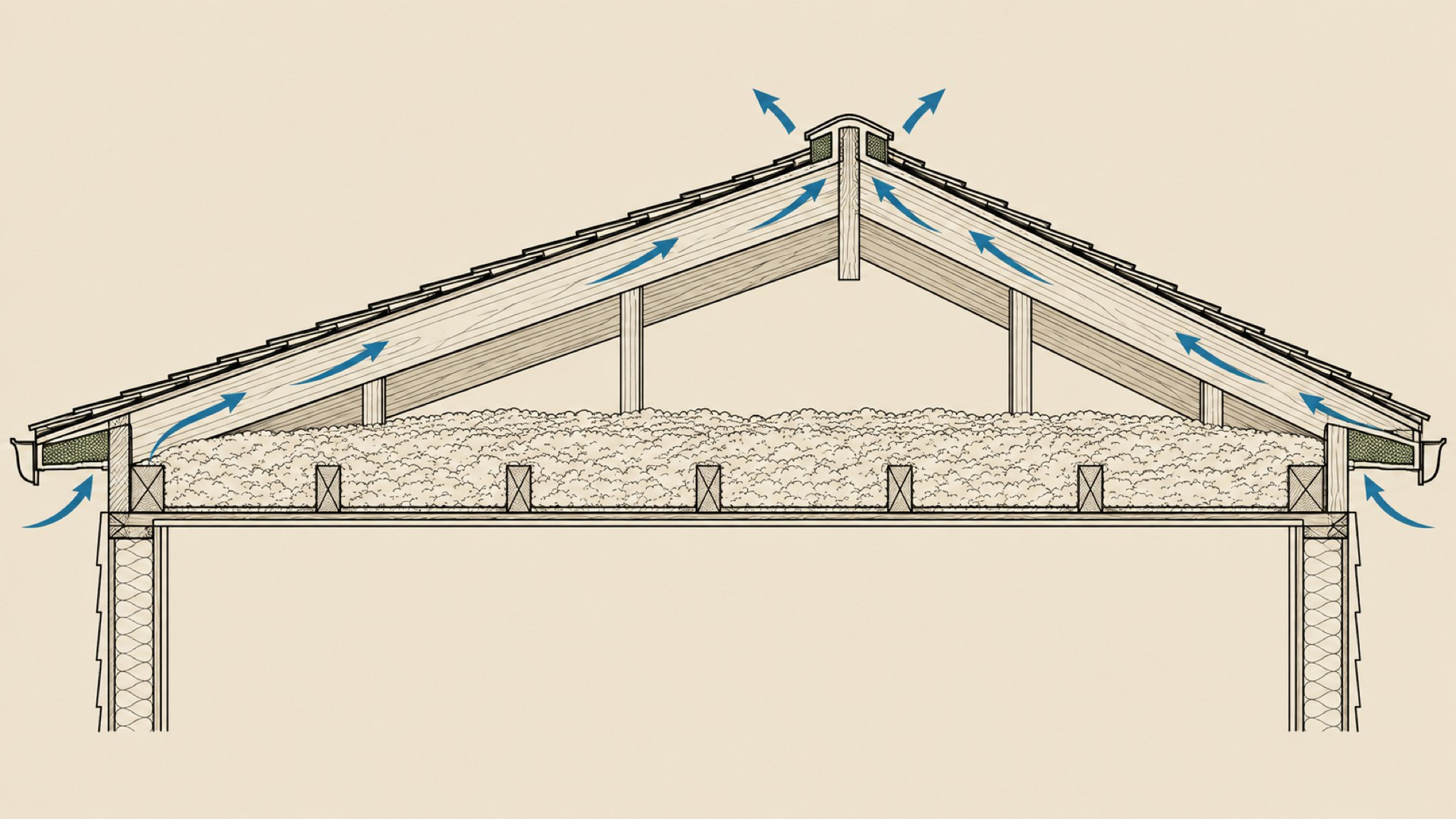
01
The ventilation circuit
An attic is supposed to pull cold outside air in low at the soffit and push warmer, moist air out high at the ridge. Insulation packed against the soffit, or a ridge vent installed with no matching intake, breaks that circuit. Without the intake side working the ridge vent does very little, and the air inside the attic barely moves.
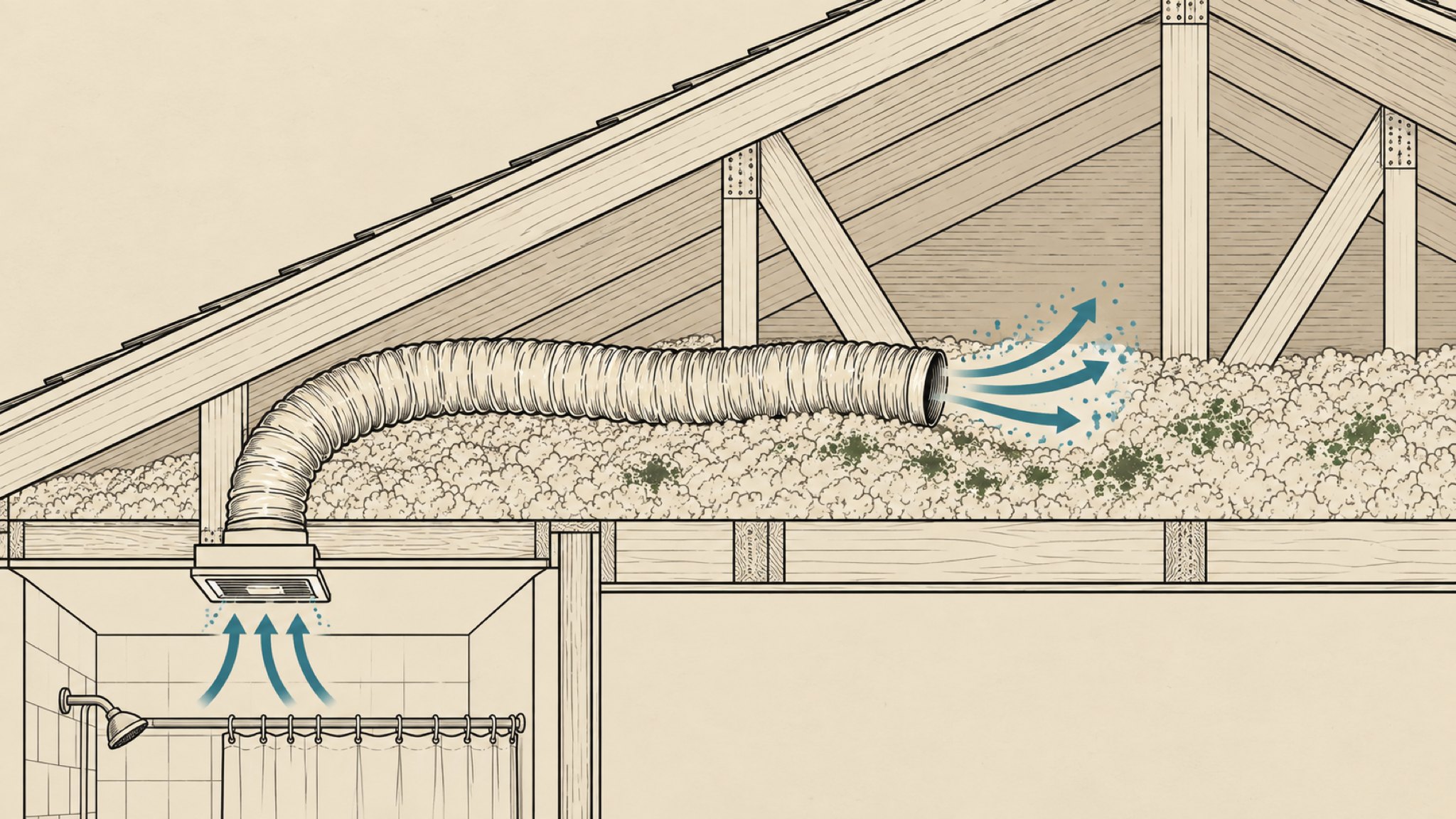
02
The fan that stops short
The duct runs a few feet into the insulation and ends there, or was never connected at all. Every shower and every load of laundry puts humid air directly into the coldest part of the house. It reads as a stain or a patch of growth radiating out from one spot, usually right above a bathroom.
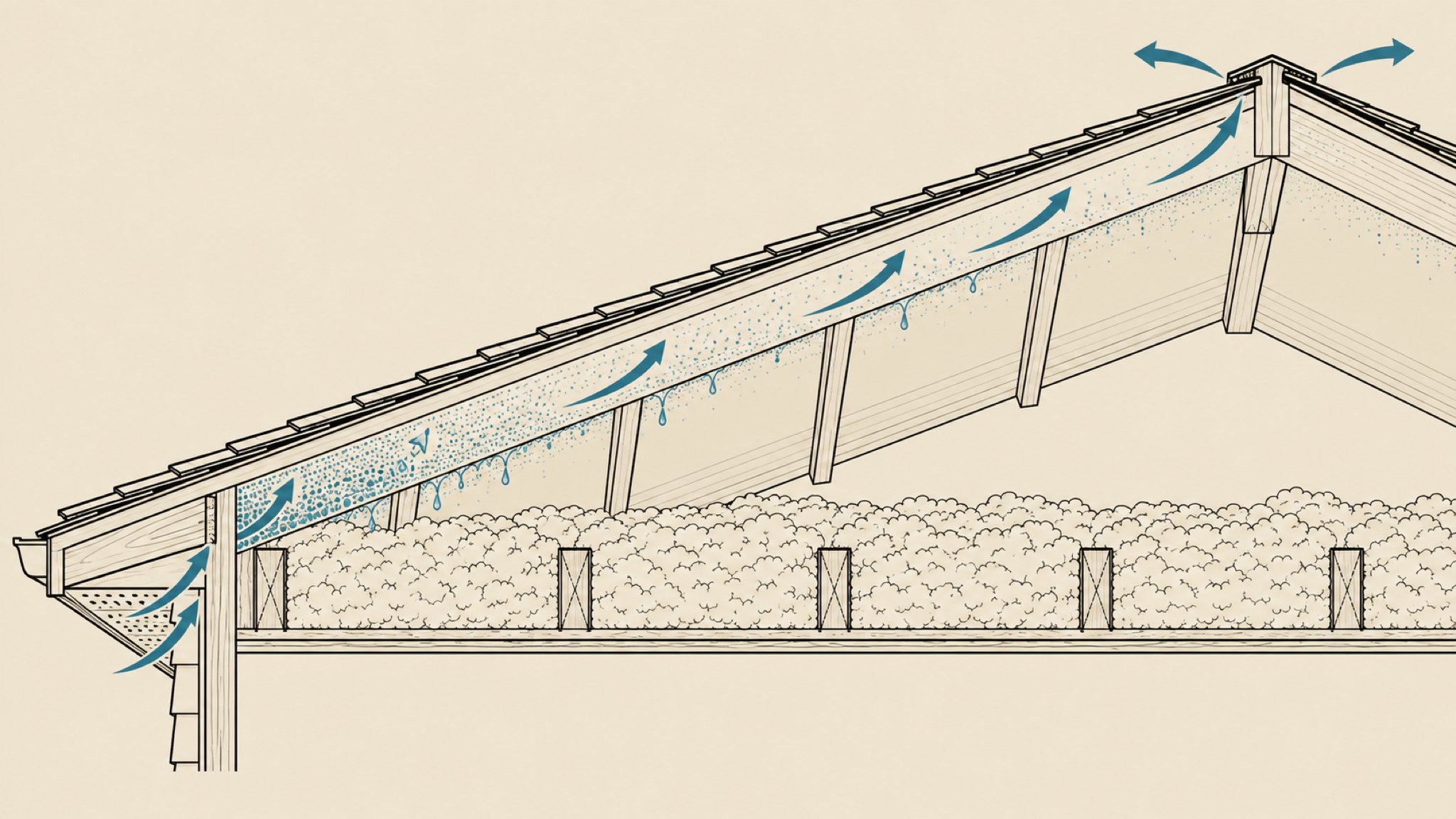
03
Frost on the sheathing
House air reaches roof sheathing sitting below freezing and frosts on the underside of the deck, the same way a cold window frosts. Nothing has to leak for this one. In late February the frost melts on its own schedule and the sheathing stays wet for weeks, because the attic is still cold enough that it does not dry quickly.
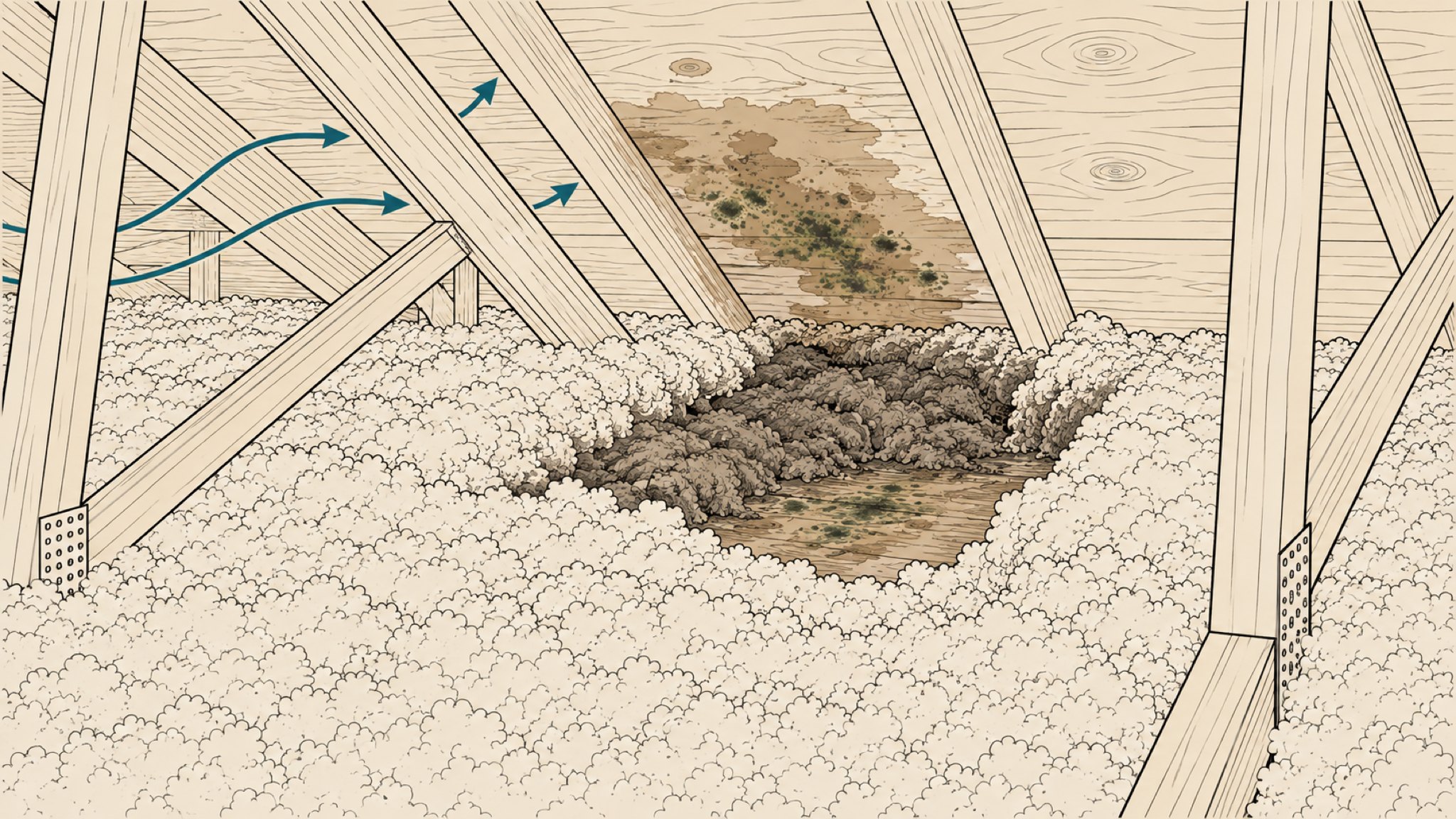
04
The insulation holds it
Blown-in and batt both drink whatever reaches them, mat down flat, and stop insulating. Wet insulation loses loft and never regains it, and it holds that water against the sheathing above and the ceiling drywall below long after the frost has melted off.
05
Growth on the deck
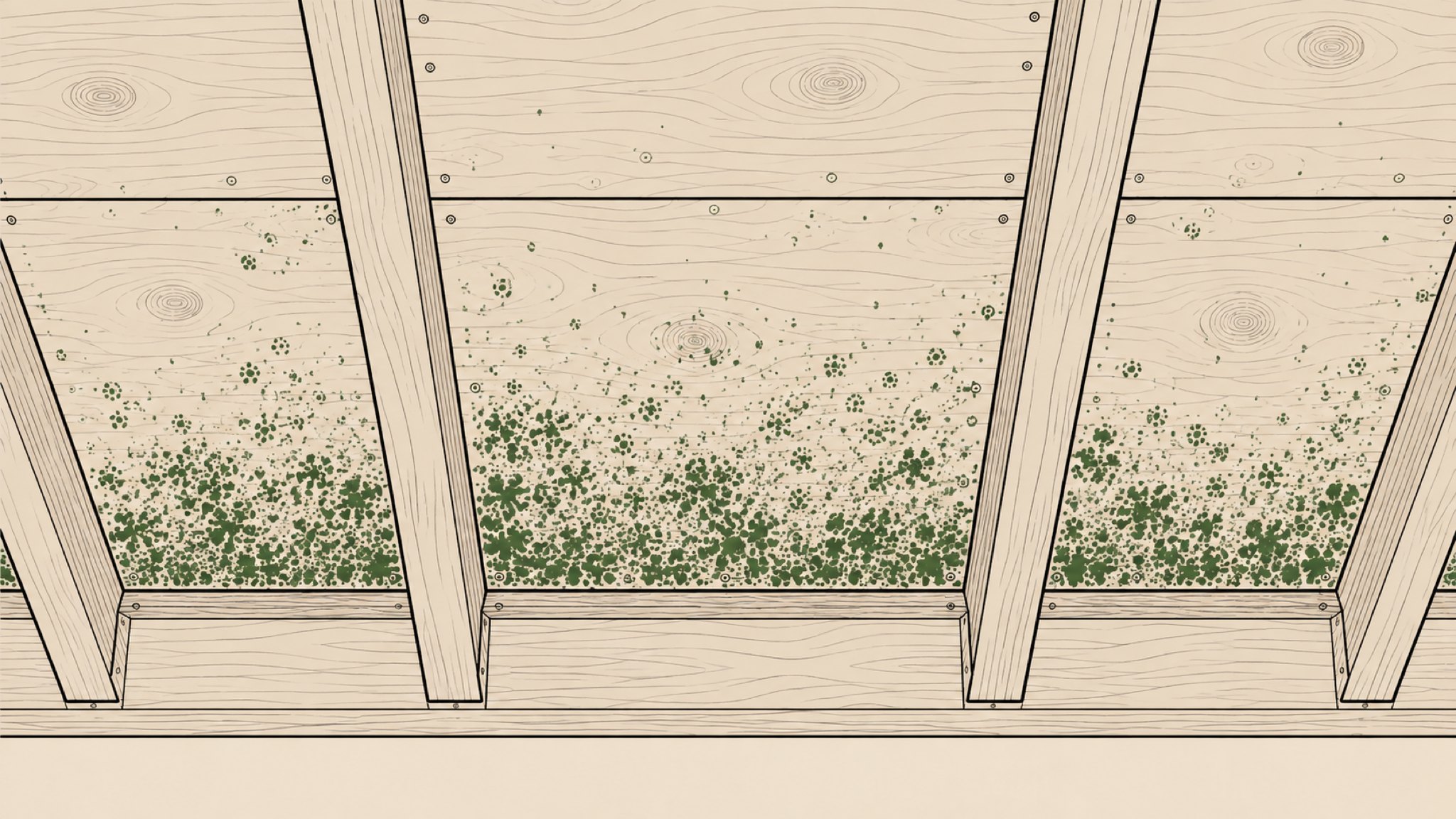
Dark gray to black, speckled, on the underside of the roof deck between the rafters, heaviest along the eaves, on north-facing slopes, and directly above bathrooms. If the sheathing reads dry on a meter, what is up there is a cleaning line on an estimate. If it is still frosting on cold mornings, the source has not been found, and cleaning will not hold past next winter.


Four defects that let the moisture in
Insulation gets blamed for this and it is not the cause. It is the multiplier. A well insulated, poorly vented attic fails faster than one that is neither, because the insulation holds whatever moisture reaches it. The four are below.
House air leaking up through the ceiling.
Every can light, the attic hatch, plumbing chases, and gaps around a whole-house fan or a chimney chase are a path for warm, moist air to reach the coldest surface in the building: the underside of the roof deck. Stack effect pulls it there the same way it pulls air up through a crawlspace, strongest on the coldest nights.
A bath fan or kitchen exhaust vented into the attic instead of outside.
This is one of the most common sources we find locally. The duct runs a few feet into the insulation and stops, or was never connected at all, and every shower or load of laundry dumps humid air directly into the coldest part of the house. It shows up as a stain or a patch of growth radiating out from one spot, usually right above a bathroom.
Blocked soffit vents and a ridge-to-soffit imbalance.
Attic ventilation is designed to pull cold outside air in low at the soffit and push warmer, moist air out high at the ridge. Insulation stuffed against the soffit, or a ridge vent installed with no matching intake, breaks that circuit. Without the intake side working, the ridge vent does very little and the air inside the attic barely moves.
Roof penetrations: plumbing vent boots, flashing, and skylight curbs.
Rubber vent boots crack from UV and freeze-thaw cycling over time and are one of the most common small roof leaks in this climate. Step flashing around a chimney or a valley that was installed short or has failed sealant does the same thing on a smaller, slower scale. These read differently than frost: a leak with a source above it, not a broad cold-surface pattern.
Almost everyone who finds a dark patch on sheathing reads it as "the roof is leaking," and a lot of roofers get called before anyone checks whether the bath fan even reaches the outside. Sometimes the roof is the answer. Just as often the roof is fine and the attic has been frosting and thawing on its own supply of house air all winter. Both get treated as roof leaks. Only one of them is.
Other sources we find up there
- A whole-house fan with a leaky or missing damper, which is effectively an open hole to the attic whenever it is off.
- An attic access hatch with no weatherstripping or insulation on the back of it, a large single gap right in the middle of the ceiling.
- A dryer vent, like a bath fan, terminating in the attic instead of through the wall or roof.
- Recessed can lights that are not rated airtight, each one a small chimney for house air.
- A prior roof leak that got fixed by the roofer, with the wet insulation underneath left in place.
- Ductwork or an air handler located in the attic, which adds both a heat source and a condensation risk if it is not well sealed and insulated.
- Snow load sitting against a poorly ventilated section long enough to keep that part of the deck at or near freezing while the rest of the attic cycles.
What growth and rot look like on roof sheathing
Growth and rot are different problems with different consequences. An attic adds a third factor that does not exist under a floor: the insulation, which holds water against the wood long after the frost has melted off it.
Microbial growth on sheathing and framing
- Dark gray to black, speckled or blotchy, on the underside of the roof deck between the rafters or trusses.
- Heaviest along the eaves, on north-facing slopes, and directly above bathrooms, in the pattern the frost and the bath-fan moisture actually make.
- It picks up the grain and the nail pattern of the sheathing, which is why a phone camera flattens it into something that looks like a stain.
- Dark does not mean biological. Roofing tar bleeds through at the nail heads, mill stamps show through, and a leak that was fixed years ago leaves a mark that never comes out. All three photograph as mold under a flashlight.
- If the sheathing reads dry, what is on it is a cleaning line on an estimate. If it is still frosting on cold mornings, the source has not been found, and cleaning will not hold past next winter.
Sheathing and rafter rot
- Decay fungi eat the wood itself. Surface growth does not, which is why a black rafter can still be perfectly sound and a clean-looking one can be soft.
- On OSB roof sheathing, rot shows as swelling, delamination, and a soft, spongy give when you press on it from below. On plywood it shows as separated layers and a darker, wet-looking stain that stays even when the surface is dry.
- On rafters and trusses, rot reads the way it does in framing anywhere: the probe sinks instead of stopping. Rafters sit above your head in the dark, so it gets found late.
- Rot needs sustained wetness, not one wet week. A moisture meter on the sheathing answers it directly: readings that stay high across repeated visits mean the source is still running.
- Rotted sheathing is a roofer's replacement, not a remediation scope. We mark it and hand off the repair; we clean and dry what is left.
Everything else worth noticing
- Insulation that is matted, discolored, or compressed flat under the affected area. Wet insulation loses loft and never regains it.
- Frost visible on the underside of the roof deck or on nail points on a cold morning, especially in the first hour of daylight.
- A ring or halo stain on the sheathing or the ceiling drywall below, radiating out from one spot: usually a fan duct, a can light, or a vent boot.
- Rusted roofing nails poking through the deck, their tips corroded rather than bright.
- A musty smell noticeable right at the attic hatch, or in an upstairs closet that shares a wall with the attic.
- Daylight visible around a roof penetration from inside the attic, which usually means a gap large enough to move air and, eventually, water.
If you are going up there yourself
- February and March are the months to look. Frost damage and ice-dam moisture are still fresh enough to read then, and an August attic has been dry for weeks.
- A headlamp pointed straight at the deck flattens everything. Stand the beam off to one side and the texture comes up: growth sits proud of the grain, a stain does not.
- Check every fan duct you can see or reach: does it actually run to the roof or a gable wall, or does it just stop in the insulation.
- Do not disturb anything you find. Attics have no floor between the joists in most of the field, loose insulation everywhere, and low headroom. Disturbing colonized material without containment sends spores down through the ceiling penetrations into the rooms below.
- If you have asthma, an allergy, or a compromised immune system, or the attic has no walkway, do not go in. Send someone else or call.
Source correction vs. full attic remediation
One is a few hours of work. The other is a containment build with insulation coming out and going back. A meter on the sheathing and a look at where each fan duct ends is what sorts them, and that happens before anybody quotes a number.
Source correction only
Fix the air leak and the ventilation. The right scope when the sheathing is dry and sound and growth has not established.
What it involves
- Ducting a bath or kitchen fan that terminates in the attic out through a gable wall or the roof, with a proper termination cap. Some of that is ours, some is an HVAC contractor's, and a new penetration through the roof itself is a roofer's. We say which is which.
- Clearing insulation away from soffit vents and installing baffles so intake air can actually reach the ridge or gable vents.
- Sealing and insulating the attic hatch, and air-sealing can lights, plumbing chases, and other penetrations from the living space below.
- Marking a cracked vent boot or a section of failed flashing for the roofer, with a tarp over it in the meantime if it is actively taking water. The permanent repair is roof work and stays with the roofer.
- A moisture reading on the sheathing before and after, to confirm the fix actually changed the reading, not just the theory.
When it’s the right call
- The sheathing reads dry on a meter and probes sound.
- Any discoloration present is old staining, not active growth, or growth is minor and confined to a small area you are comfortable having cleaned as a smaller item.
- The cause is clearly identified: a disconnected fan duct, blocked soffits, an unsealed hatch.
- This is most of the calls that start as "I think my roof is leaking" and turn out not to be.
What it does not fix
- Existing growth. Sealing the air leak stops new moisture; it does not clean what is already on the wood.
- Wet or matted insulation already in place. That has to come out regardless of what caused it.
- A structural problem in the roof itself: rotted sheathing, failed framing, or a shingle or underlayment failure that needs a roofer.
Full attic remediation
Containment, wet insulation removed, sheathing cleaned, moisture source corrected, and new insulation blown back in.
What it involves
- Everything in source correction, plus the cleanup.
- Containment at the hatch and negative air exhausting outside, so nothing disturbed in the attic reaches the rooms below through can lights and other ceiling penetrations.
- Removal of insulation that is wet, matted, or sitting directly under the affected sheathing. It does not get dried in place.
- HEPA vacuuming and cleaning of sheathing, rafters, and trusses, with sanding or media blasting where growth has gone into the wood grain.
- Drying of the roof deck with readings at marked points until it matches sheathing elsewhere in the same attic.
- New insulation blown back once the deck is dry and clean, sized to the space, not just topped off over the old.
When it’s the right call
- There is visible growth across more than a small, contained area.
- Insulation under the affected roof section is wet, matted, or has lost its loft.
- The attic has frosted or leaked more than one winter running.
- Ductwork or an air handler in the attic has been exposed to the moisture.
What it does not fix
- The moisture source, if it is not corrected as part of the same job. Cleaning sheathing and reinsulating over an unducted bath fan just resets the clock on next winter.
- Rotted sheathing or framing. That is a roofer's structural repair, done before the attic is closed back up, not hidden under new insulation.
- A roof leak from a failed shingle, underlayment, or flashing system. We tarp and trace it. Permanent repair is a roofer's scope.
Insulation is not a moisture barrier. It holds whatever is wet against the wood longer than bare sheathing would.
What usually turns out to be enough
A real share of the attic calls we get end at source correction: reroute the fan, add baffles at the soffits, seal the hatch, and the sheathing was never wet enough to grow anything in the first place. That is a few hours of work compared to a full remediation, and it solves the actual problem instead of hiding it under new insulation.
The reverse mistake is common too: someone reinsulates over a wet, matted section because the growth was not obvious from the hatch, and the smell comes back within a season. Insulation is not a moisture barrier. It holds whatever is wet against the wood longer than bare sheathing would.
Two things we will not do. We will not quote a full remediation before a meter has been on the sheathing and the source has been found. And we will not cut a new penetration through your roof to vent a fan out, because that is roof work and it belongs to a roofer carrying roofing insurance. We will say which contractor you need and coordinate with them.
Your home inspector wrote "mold in the attic"
Common in a real estate transaction, and the wording in the report is almost always hedged. There is a reason for that, and it is not that the inspector is being cagey.
A home inspector is reporting what they saw through a hatch or from a walkway board, usually without going far into the field of the attic. "Apparent microbial growth, recommend evaluation by a qualified party" is not a lab result. It means someone should go look with a meter, not that the house has a confirmed problem.
That sentence means an inspector saw something worth a second look. It is not a diagnosis of your house, and it is not a number you can negotiate against. Attics are easier to reach than crawlspaces, so more of them get photographed thoroughly, and more of what gets photographed turns out to be old, dry, and cosmetic.
An inspector saw something worth a second look. A meter tells you whether it is still happening.
Four things it commonly is
- Old frost staining from a winter or two ago, on sheathing that reads bone dry now.
- Nail-head bleed-through or roofing tar migration, which is dark and blotchy but is not biological growth at all.
- A contained patch directly above one bathroom, caused by a fan duct that was never connected, with the rest of the attic clean.
- Genuine active growth, confined and explainable, once a moisture source is identified.
What sets the scope
Whether the sheathing is wet or frosting right now.
A meter reading on a cold morning answers this directly. Dry sheathing with old staining is a cosmetic question. Sheathing that is still cycling wet is an active problem.
Whether the deck and framing are still structurally sound.
Growth is a surface condition and we clean it. Delamination, swelling, and sheathing that gives when you press on it from below are structural, and that repair belongs to a roofer. The two get confused because they photograph the same.
Whether the moisture source has been identified.
If the bath fan still dead-ends in the attic, whatever gets cleaned or reinsulated is temporary. It is a common miss in a quick pre-listing cleanup.
How much of the field is affected, and whether it lines up with a known cause.
A patch above one bathroom with a disconnected duct is a contained job. Growth spread across multiple roof slopes with no obvious single cause takes longer to diagnose and price.
If you are closing soon
- Before you negotiate a price, get a number off the sheathing. A photograph in an inspection report is not something the other side has to accept. A dated reading is.
- Ask whether the fan ducts were actually checked. "No visible leak" is not the same as "the bath fan is ducted outside," and the second question is usually the one that matters.
- You generally do not need a lab test to decide whether visible growth on the sheathing should be cleaned. Sampling earns its cost when there is a smell with nothing visible, or to verify a cleanup after the fact.
- Ask for readings and photos mapped to locations in writing. That document is what a lender, a buyer's agent, or the other side's inspector will actually read.
What is urgent in an attic and what can wait
The dividing line is whether the sheathing is taking on water right now. A meter at a marked point answers that before anyone writes a scope, and the two lists below split on that one reading.
Call now
- Water actively dripping from a ceiling, or a stain that is spreading while you watch it.
- An ice dam visibly backing water up under the shingles, or icicles combined with a fresh interior ceiling stain.
- A sagging or stained ceiling that is soft to the touch, which means water has been sitting in the insulation or drywall above it.
- Wet, matted insulation from any cause, which will not dry on its own and is actively holding moisture against the sheathing and the ceiling drywall.
- Frost or condensation on the underside of the deck combined with a musty smell noticeable in an upstairs room.
- A roof penetration with visible daylight around it, or a vent boot you can see is cracked and open.
- Ductwork or an air handler in the attic that has been rained or snowed on through an open section of roof.
Schedule it
- Old, dry staining with a sheathing moisture reading that matches the rest of the attic.
- A bath fan confirmed disconnected but the sheathing above it is currently dry.
- Blocked soffit vents with no active growth, found during an unrelated project like a re-roof or insulation top-off.
- A small, contained patch of surface growth that reads dry, with the source already identified and scheduled to be fixed.
- General under-insulation with no moisture evidence, a comfort and efficiency question rather than a restoration one.
Here is how it usually goes wrong. A roof leak gets tarped and traced, everyone treats the attic as solved, and the bath fan that has been dumping moisture up there for years never comes up because nobody went looking for a second source. The roof stops leaking. The attic keeps frosting every winter anyway.
What a Peak attic assessment includes
An attic has no floor across most of the field and usually has a roof somewhere in the argument, so the visit is built around getting a meter onto the sheathing safely. You end up holding the readings whether or not we do the work.
What the visit covers
- Entry and traverse on the walkway boards or the trusses, out to the far end of the field. The view from the hatch misses the eaves, which is where the pattern is.
- Moisture content readings on the roof sheathing at marked points, including a reading on unaffected sheathing in the same attic for comparison.
- A check of every fan duct, dryer vent, and roof penetration we can reach: whether it is connected, where it actually terminates, and whether anything is wet around it.
- Soffit and ridge vent condition: blocked, baffled, or open, and whether the intake and exhaust sides are actually balanced.
- Insulation condition: matted, compressed, or holding water, and how far the affected area extends.
- Probe testing on sheathing and framing where discoloration or softness is present.
- Temperature and dew point readings where they explain a frost or condensation pattern.
- Thermal imaging where it earns its place: finding a heat-leak path from the living space that is not visible by eye.
- An exterior and roof-edge walk where safe to do from the ground: eave condition, gutter and downspout function, and visible ice-dam history like stained or curled shingles at the eave.
- Numbered photographs mapped to the locations they were taken.
What the report contains
- A sketch of the attic with every reading location numbered on it.
- Every reading, with its location, the date, and the time it was taken.
- Photos numbered to match the sketch.
- A plain statement of the moisture source, or the ranked candidates if more than one is present, and what would confirm each.
- Whether the sheathing and framing are structurally sound, and specifically where they are not.
- A clear split between what is ours (cleaning, drying, insulation, air-sealing, vent correction) and what belongs to a roofer or an HVAC contractor, so nobody is waiting on us for a repair we do not perform.
- Urgent and maintenance items, separated.
- If it becomes an insurance claim, the same file in the format a carrier expects.
- The whole report on your own job page, so you can send a link to a buyer, an agent, a lender, or an adjuster instead of forwarding a PDF.
We do not test our own work and we do not replace roofs. Clearance sampling, when a sale or a health concern calls for it, goes to an independent inspector with no financial interest in the remediation. Roof repair and replacement go to a roofer we coordinate with directly.
Questions we get about attics
My ceiling stained in February with no storm that week. What happened?
Almost always frost or an ice dam, not a sudden leak. Warm house air leaking into the attic frosts on cold roof sheathing all winter, and it melts on its own schedule as the weather warms in late February and March, weeks after the coldest nights. An ice dam works the same way from the outside: melted snow refreezes at the cold eave and backs water up under the shingles. Neither one needs a storm. Both need a source of heat or moisture leaking into the attic, which is the thing worth finding.
Is the dark staining on my sheathing dangerous mold?
Color and a phone photo do not identify a species, and a lot of dark sheathing staining is not biological at all: roofing tar bleed at the nail heads, old water marks, or mill stamps. What decides the job is the meter reading and the probe, in that order. Whatever the species, the sequence does not change: correct the moisture source, remove what cannot be cleaned, HEPA clean the rest, and take a reading that proves it dried.
Do I need to replace my roof if there is mold in the attic?
Not usually, and we would not be the ones to tell you that anyway. Growth on sheathing is a cleaning and drying scope in most cases. A roof only needs work if the deck has actually delaminated or rotted, or if the leak source is a roofing failure like a cracked vent boot or bad flashing. We tarp and trace leaks and mark structural damage for a roofer. Full roof repair or replacement is a roofing contractor's scope, and we coordinate with one directly rather than estimating that work ourselves.
Why does my bathroom fan matter if it's just a fan?
Because of where the duct actually ends. A bath fan moves a real amount of humid air every time it runs, and if that duct stops a few feet into the attic insulation instead of exiting through the roof or a gable wall, every shower is a small humidity event directly under the coldest surface in the house. It is one of the most common sources we find locally, and it is usually a short fix once it is identified.
Should I get a mold test for the attic?
Rarely, and almost never first. If you can see growth on the sheathing, a lab result will not change the cleaning scope, and the question that does change it is whether the deck is still getting wet. The two cases where a lab is worth the money are a smell nobody can locate and a cleanup somebody needs signed off. Peak does not take samples or clear its own work, so when a test is genuinely called for we send you to an independent industrial hygienist and you hire them directly. The Idaho Mold Guide carries the longer version of this, including why that separation matters.
Will insurance cover mold or water damage in my attic?
It depends on the cause. An ice dam that forces water in through the roof is often a covered peril, sometimes with a mold sublimit on the policy. Frost and condensation from house air leaking into the attic over a normal winter is generally treated as a maintenance issue and is usually not covered, the same way long-term crawlspace seepage usually is not. Either way you get the same file: dated sheathing readings at marked points, photographs numbered to a sketch of the attic, and one named cause. A claim built on the wrong cause falls apart with the adjuster.
Can I clean the attic myself?
Only for a small, dry, easily reached patch with the source already corrected, and even then the footing is the first problem. Past the walkway boards most attics have no solid floor between the joists, so you are working off trusses in low headroom with a light in your teeth. The second problem is that disturbing growth up there without containment sends spores down through every can light and ceiling penetration into the rooms below. And none of it holds until the fan duct or the ventilation fault is corrected.
My inspector flagged attic mold and we close in two weeks. What do I do?
Start with a number off the sheathing, taken on a cold morning if you can arrange one. Whether the deck is still cycling wet, whether it is still sound, and whether anyone has traced the moisture back to a fan duct or a blocked soffit: those three decide the negotiation. A photograph in the report decides nothing. Most of these turn out to be old staining or a small, contained, fixable problem, and finding out which one you have before closing is worth more than the assessment costs.
How much does attic mold removal or remediation cost?
Four things move the number: how many square feet of sheathing are affected, how much insulation comes out and goes back, whether cleaning is enough or the wood needs sanding or blasting, and how hard the attic is to work in. Source correction is usually its own line, and part of it may belong to an HVAC contractor or a roofer. Nobody should quote it from the driveway. The number comes after a meter and a look.
Related
Attic assessment
Sheathing readings at marked points, photos numbered to a sketch of the attic, and a written split between what is ours and what is a roofer’s. Call and describe what you found, or send it in writing and we respond within 24 hours.