
The Idaho Crawlspace GuideGround moisture under Treasure Valley houses.
Most of the moisture problems we get called out for in the Treasure Valley start under the floor. Some of them are plumbing. A large share of them are not. They are ground water, on a schedule, in a dry climate where nobody thinks to look down. This page covers how to tell which one you have.
- Canals charge early April · shut down early October
- Semi-arid valley · ~13 in of rain a year
- IICRC certified · RCE-67387
Anatomy of a crawlspace
Most homeowners have never seen under their own floor. This is what is down there, what the moisture does to it, and what the fixes actually are, one picture at a time.
01
The structure
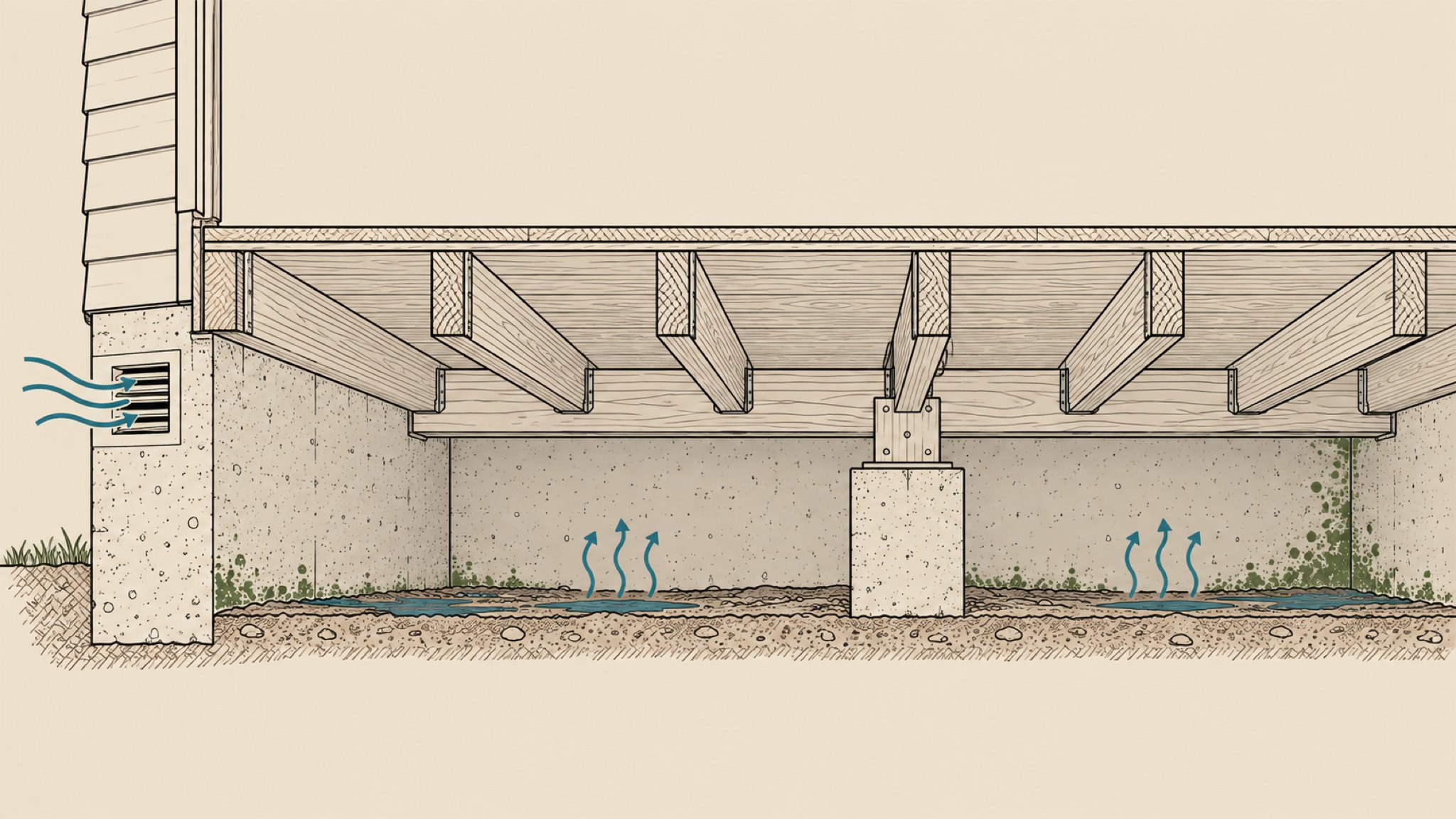
A concrete stem wall runs around the perimeter, with a pier and girder carrying the middle of the house. A wood sill plate sits on the concrete, the floor joists bear on it, and the subfloor rides on top, that is the floor you walk on. Every framing member in this picture is wood, sitting a few feet above bare soil.
02
The insulation
Most crawls in the valley have fiberglass batts stapled up between the joists. Dry, they insulate. Wet, they sag, hold water against the subfloor, and eventually fall, sagging insulation is usually the first visible sign of a problem, and you can see it from the hatch. A sealed crawl insulates the stem walls instead.
03
Ground moisture
Bare soil gives off water vapor continuously, even when it looks dry, and under irrigated ground it stays damp far longer than thirteen inches of annual rain would suggest. The vapor rises and condenses on the coldest surfaces it can find: ductwork, pipes, and the underside of the subfloor. This runs every hour of every day.
04
The vapor barrier
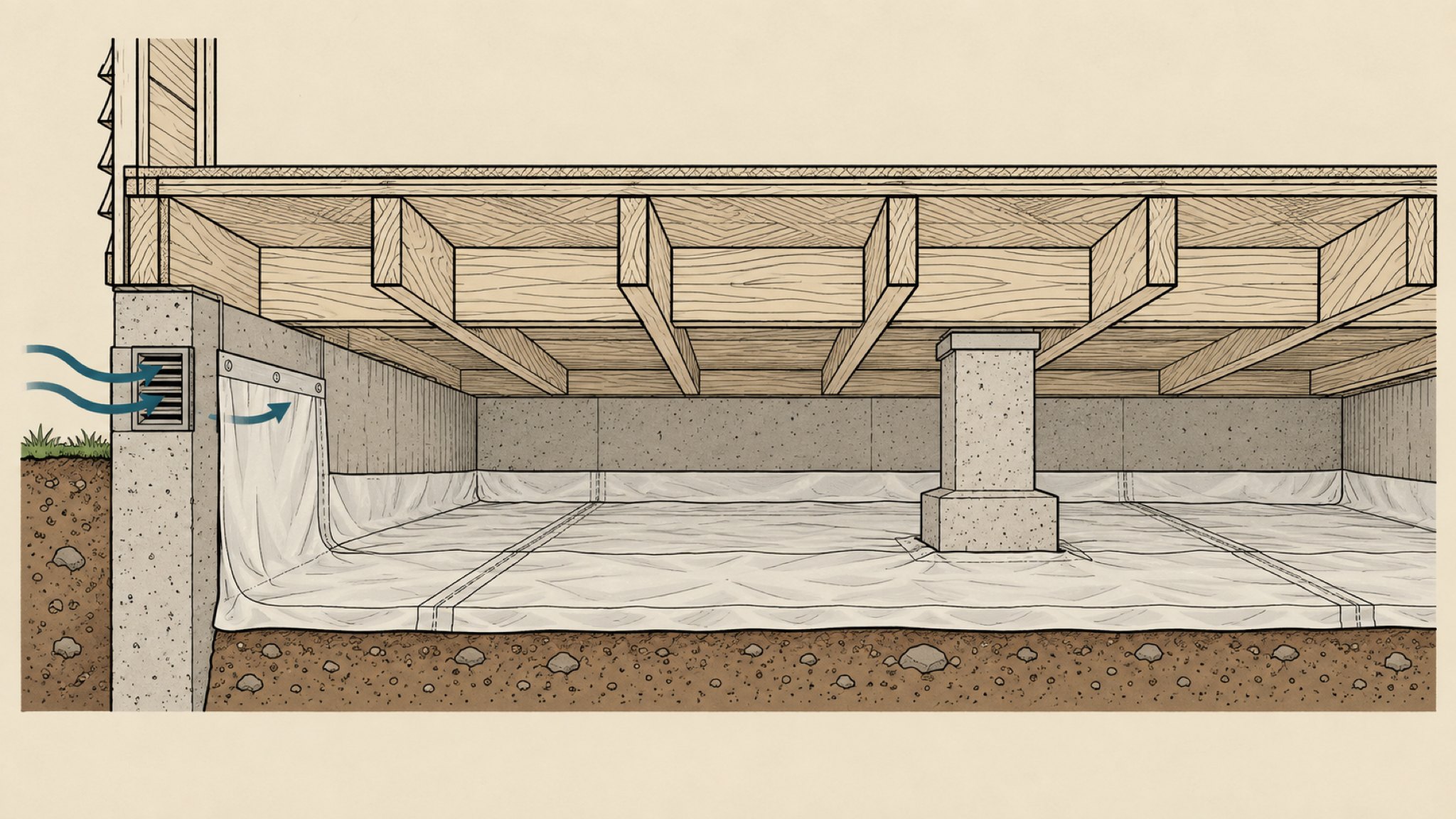
The barrier is plastic sheeting over the soil, commonly 6 to 12 mil, and installation is the whole game: seams overlapped and sealed, the material run up the stem wall, cut tight around the piers. Laid loose with open seams and stopped short of the wall, it is two pieces of plastic, not a barrier. And every trade that crawls through it tears it.
05
Encapsulation
A full encapsulation brings the crawl inside the building envelope. A heavier liner, commonly 12 to 20 mil, is sealed to the stem walls and piers rather than laid loose; the vents close, the rim joist gets air-sealed, and a dedicated dehumidifier or a small conditioned-air supply controls the humidity. Bulk water gets handled first, sealing a crawl that floods traps the water under the liner.
06
The vents
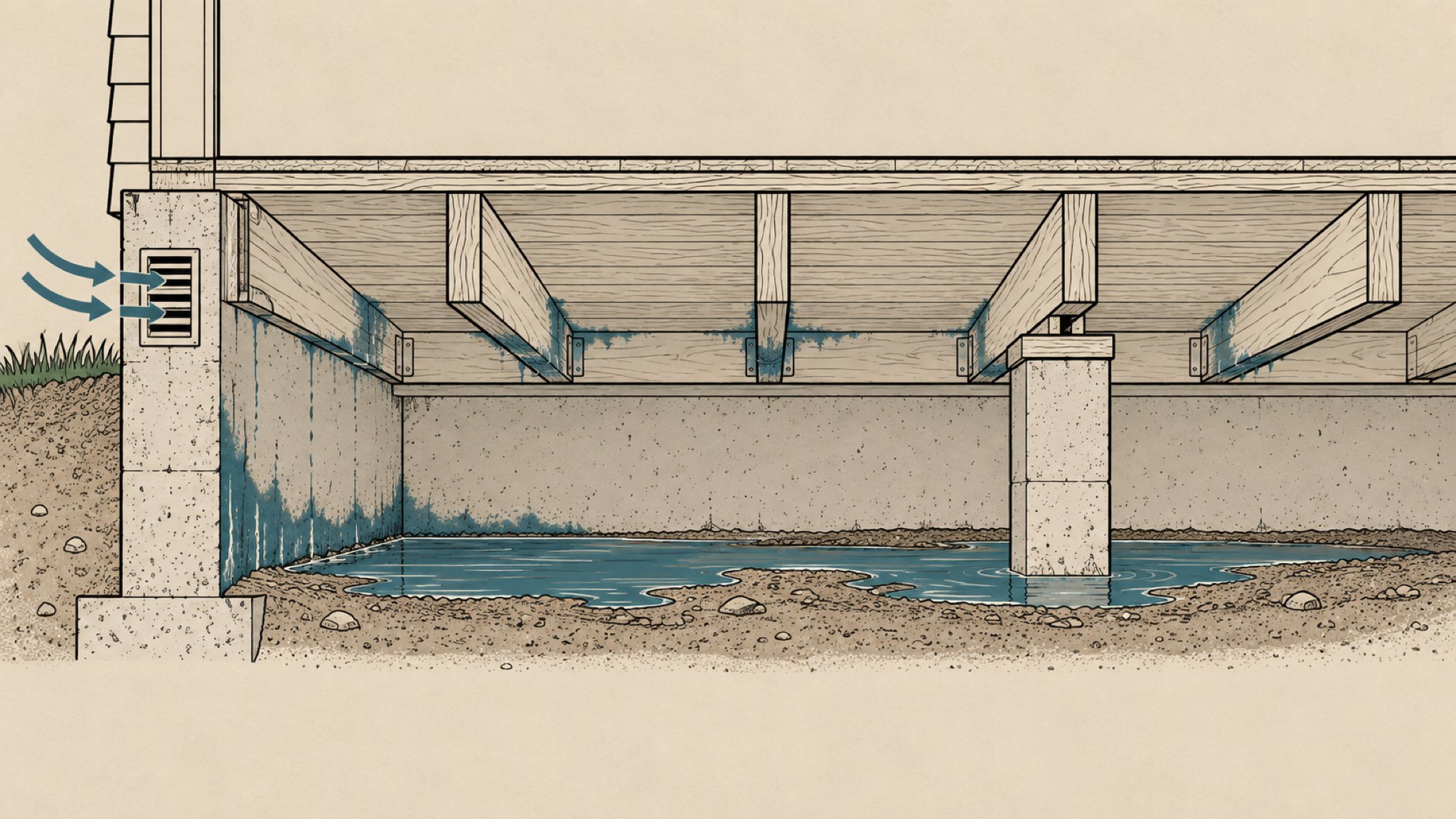
Foundation vents were meant to dry the crawl with outside air. On a humid summer day the physics runs backward: outside air carrying moisture crosses surfaces that stay cool under the house, and the water condenses onto the wood, the vent makes the crawl wetter, not drier. In a sealed crawl the vents close and the humidity is controlled instead of imported.
07
When it floods
This is what May looks like on a lot near a canal or a lateral: the water table comes up with irrigation season and standing water spreads across the crawl with nothing leaking anywhere. Insulation soaks and falls. Joists and subfloor take on water from below, and every day they stay wet moves them toward the moisture level where decay fungi go to work. The plumber will find nothing, because nothing is wrong with the plumbing.
08
Dried and restored
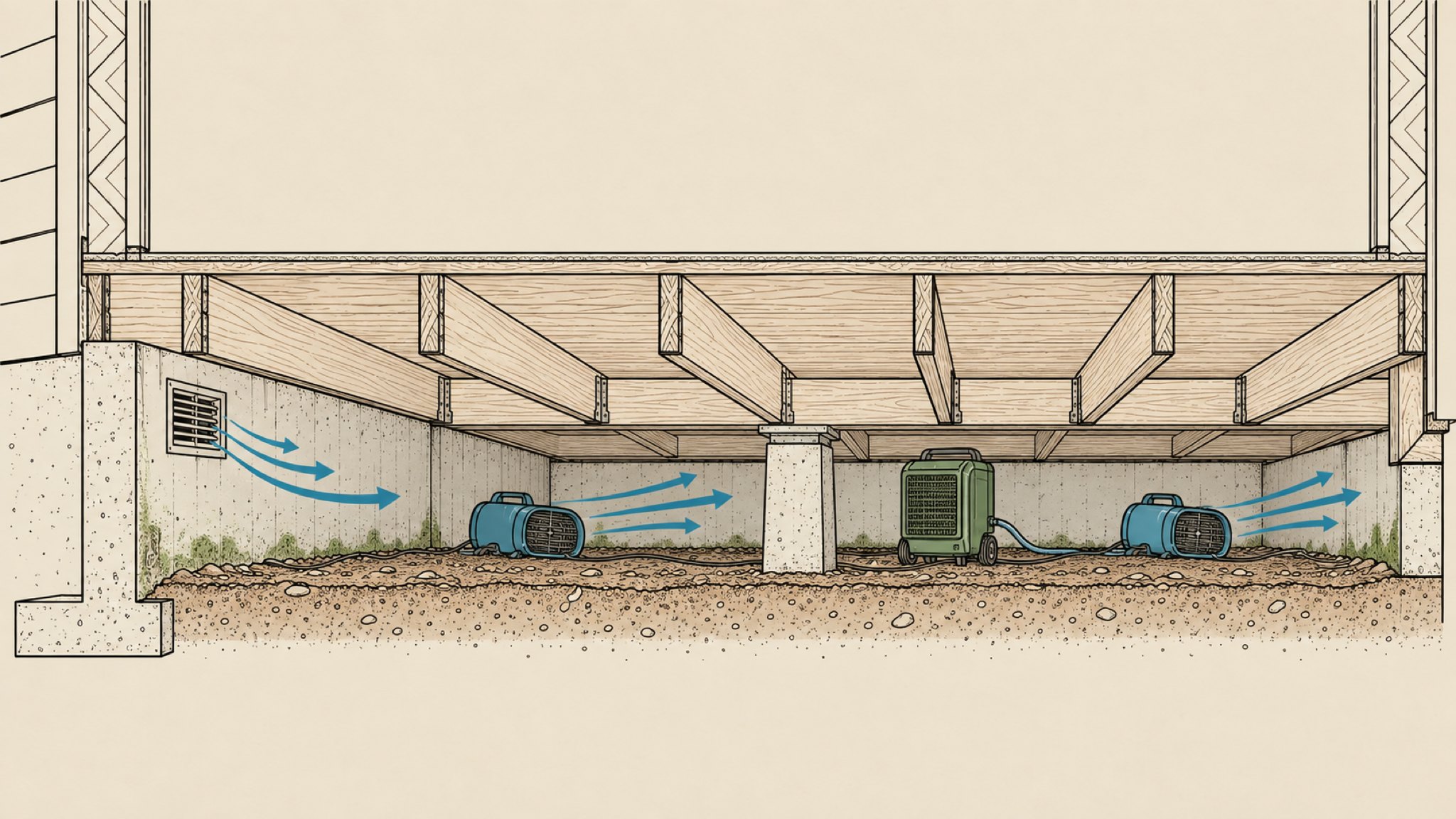
The order matters: bulk water out, then drying to documented moisture readings, then the barrier or liner installed correctly, and drainage and a sump first if ground water is the source. Framing comes back into the 8 to 15 percent range a dry crawl reads. Done in that order it stays fixed. Done out of order, you paid to cover the problem up.


The canals charge in April. Crawlspaces go wet in May.
This is the single most useful thing on this page.
The Treasure Valley runs on gravity irrigation. The Boise Project operates roughly 1,500 miles of canals, laterals, and drains across southwest Idaho, and the system starts filling in the first days of April. Deliveries begin about a week after that, once the canals reach elevation. The districts shut it all down in the first week of October.
Those canals leak on purpose and by accident. State hydrology work in this valley attributes the large majority of recharge to the shallow aquifer to canal seepage and flood irrigation, not to rain. Boise gets about thirteen inches of precipitation a year. The ground under this valley is wet because we make it wet, every year, starting in April.
So the water table under a lot near a canal, a lateral, or flood-irrigated ground comes up when the water turns on. A crawlspace that was dry all winter can take standing water in May with nothing leaking anywhere in the building.
The call goes the same way every year. A homeowner smells something in the hallway in late spring. They call a plumber. The plumber pressure-tests the system, isolates the fixtures, finds nothing, and leaves. Nothing is wrong with the plumbing. The ground got wet on schedule.
Where we see it
- Canyon County generally: Nampa, Caldwell, and the farm ground between them run on gravity irrigation and sit over a shallow table.
- Acreage parcels outside Kuna and Star where laterals cross the property.
- Both Boise River channels around Eagle Island, and the Two Rivers and Banbury area, on river gravel with a high table.
- Southeast Boise and the Barber Valley / Harris Ranch side, close to the river.
- Any older parcel anywhere in the valley with a ditch right and a lateral running through it.
- Middleton and the river-adjacent stretches along Highway 44.
How to tell ground water from a plumbing leak
It starts in April or May, and it did not happen in February.
A plumbing failure has no season. Ground water here does. If the crawl was dry through a wet March and went wet in the second week of May, look at the calendar before you look at the pipes.
The water is on the ground, not running down anything.
A leak leaves a track: a wet line on a joist, a drip path on a pipe, a stained cone on the soil under one fixture. Ground water comes up broadly, level, with no source above it.
It is spread across the crawl, not concentrated under one room.
Plumbing is concentrated. Supply lines and drains run in known places. A wide, shallow sheet of water across half the footprint is not coming from a half-inch line.
It comes back the same time next year.
Repaired plumbing stays repaired. A seasonal water table does not care what you fixed.
The plumber tested it and found nothing.
That is not an inconclusive result. It is a result. Take it seriously and start looking at grade, downspouts, and the irrigation calendar.
This matters for your claim, and the news is not good. Water that comes up through the ground is flood under essentially every standard homeowner policy, and flood is excluded. A sudden pipe break in the crawlspace is usually covered. A crawlspace that fills every May from a rising water table generally is not. We tell people this on the first phone call rather than at the end of the job.
Why Idaho crawlspaces fail
Three things, and they compound. Individually each one is survivable. Together they are the reason a house in a semi-arid valley smells like a basement in Ohio.
Ground moisture. Bare or barely covered soil gives off water vapor continuously.
Soil under irrigated ground stays damp far longer than thirteen inches of annual rain would suggest. That vapor moves up into the crawl every hour of every day, and it lands on the coldest surface it can find: the ductwork, the pipes, the underside of the subfloor.
Stack effect. Warm air leaves the top of a house, and replacement air comes in at the bottom.
The bottom of most homes here is the crawlspace. Air that has been sitting on wet soil gets pulled up through the floor assembly, past every wire penetration and plumbing chase, and into the living space. That is why the hallway smells musty in January and nobody can find anything wrong upstairs. It is strongest in winter, when the indoor-outdoor temperature difference is largest.
A failed or absent vapor barrier.
Pre-1970 stock around the valley frequently has bare dirt and nothing else: Old Nampa, the Boise North End and Bench, downtown Caldwell, older Meridian, the farmhouses. Newer subdivision homes usually have a barrier, but it is laid loose, unsealed at the seams, and stopped short of the stem wall, so ground moisture still loads the joists. And every barrier gets torn: HVAC techs, plumbers, cable installers, and insulation crews all crawl through it, and none of them tape it back.
The trap here is the dry climate. July relative humidity in this valley runs in the twenties and thirties, so people assume moisture is an Oregon problem. Outdoor air genuinely is dry most of the summer, and the foundation vents genuinely do help in August. They do very little in April and May, when the ground is wet and the air is cool. The moisture is coming from under the house, not from the weather. In a wet climate people blame the sky. Here nobody looks down.
And the ones that have nothing to do with the ground
- Downspouts discharging at the foundation. A single downspout dumping at the corner of the house puts more water under a crawl in one storm than most plumbing leaks do in a month.
- Negative grade: soil sloped toward the house, or a flowerbed built up above the top of the stem wall.
- Irrigation heads spraying the foundation. Set them to miss the house, and check them again after anyone mows.
- Air conditioning condensate lines that terminate in the crawl instead of outside it.
- Evaporative coolers charged in spring, which leak the week they are turned on and again the fall they are not drained.
- A dryer vent that came apart and is now discharging warm, wet air directly under the floor.
- Leaky or disconnected ductwork, which pressurizes the crawl and moves crawl air into the house.
- Missing or crushed insulation at the rim joist, which puts a cold surface right where the moist air is.
What it actually looks like down there
You can learn most of this with a flashlight and twenty minutes. The one thing worth knowing before you go: growth and rot are different problems with different consequences, and people routinely panic about the one that matters less.
Microbial growth on framing
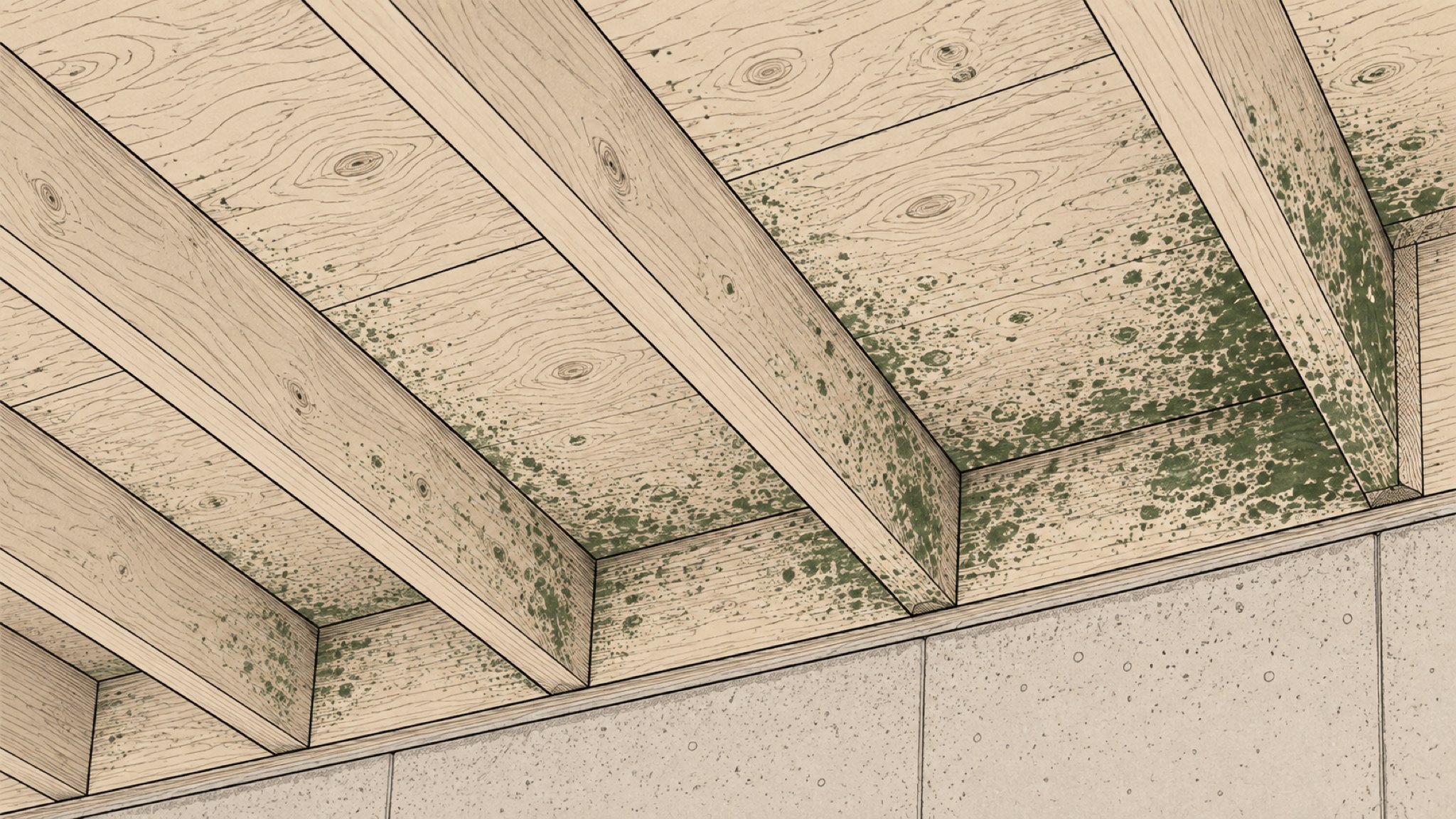
- Usually white, gray, green, or black. Fuzzy, powdery, or speckled, not flat like a stain.
- It follows the grain of the wood and the edges of the subfloor sheets, and it is blotchy rather than uniform.
- It is heaviest where air does not move: the perimeter, the corners, behind ductwork, and the far end from the access hatch.
- It is often worst directly under bathrooms and kitchens, and along the north side of the house.
- Not everything dark is growth. Mineral staining from concrete, old dried water marks, overspray from a previous treatment, and soot from a shop or a wood stove all read as "mold" in a photo.
- Growth on framing that is dry right now is a cleaning problem. Growth on framing that is wet right now is a moisture problem that has not been solved yet.
Wood rot: the one that matters more
- Rot is decay fungi consuming the wood itself. Growth sits on the surface. Rot removes structure.
- Brown rot leaves the wood dry, light, and cracked into small cubes across the grain. It crumbles between your fingers.
- White rot leaves it spongy, stringy, and bleached or mottled. It feels soft rather than brittle.
- The test is a screwdriver or an awl. Push it into the bottom edge of a joist with normal hand pressure. Sound framing stops it. If the tip sinks a quarter inch or more, that is rot.
- Probe at the perimeter, at the piers, near any plumbing, and under bathrooms. Those are where it starts.
- Rot needs sustained wetness. Decay fungi generally need wood held above roughly 28 to 30 percent moisture content to work, far above the 8 to 15 percent a framing member in a dry crawl will read. That is why a moisture meter answers the important question faster than a lab does.
- Rot is a structural conversation and a framing repair. It is not remediation, and cleaning it does nothing.
Everything else worth noticing
- Fiberglass batts sagging, hanging, or dark on the underside. Insulation falls before anything else shows, and it is visible from the hatch.
- Condensation beading on ductwork, on cold water lines, or on the underside of the subfloor.
- Efflorescence, a white powdery crust on the stem wall or piers. It means water has moved through the concrete and left minerals behind.
- A water line on the piers or the stem wall, higher than anything is wet now. That is a record of how deep it got, and when combined with the irrigation calendar it usually explains itself.
- Soil that holds a footprint, or that is visibly darker than the soil at the hatch.
- A musty, earthy smell when you open the access door, and the same smell in a hallway or a closet upstairs in winter.
- Rusting duct straps, joist hangers, or nail plates.
- Floors above that feel spongy, dip, or have developed a slope since you moved in.
If you go down there yourself
- Go in the spring, not in August. April through June is when the valley shows you the truth.
- Hold the flashlight low and rake the beam sideways along the joists. Straight-on light hides texture; raking light shows it.
- Do not disturb anything you find. Scrubbing, sweeping, or aiming a fan at growth releases spores through the whole house in about ten seconds.
- Photograph from the hatch and from a few feet in, with something in frame for scale.
- If you have asthma, an allergy, or a compromised immune system, do not go in. Send someone else or call.
Vapor barrier replacement vs. full encapsulation
Two different jobs at two very different prices. The data that decides between them is a moisture reading and a winter humidity reading, not a sales visit.
Vapor barrier replacement
New sheeting over the soil, sealed at the seams and run up the stem wall. The baseline fix for routine ground moisture.
What it involves
- Clear the crawl: old plastic, construction debris, offcuts, and anything organic sitting on the soil.
- Regrade the soil where it is uneven or where water pools, so the sheeting lies flat and drains toward the low point.
- Lay new sheeting across the entire soil floor, commonly 6 to 12 mil for a straight barrier replacement.
- Overlap the seams and seal them. An unsealed overlap is not a barrier; it is two pieces of plastic.
- Run the material up the stem wall, then mechanically fasten and seal the top edge.
- Cut and seal tightly around every pier, post, and penetration.
- Reinstall or repair fallen insulation and reconnect anything found disconnected while we are down there.
When it’s the right call
- The soil is damp but there is no history of standing water.
- Framing probes sound and reads dry on a meter.
- The existing barrier is torn, short of the walls, or missing entirely.
- The goal is to stop routine ground vapor from loading the floor assembly.
- This is most subdivision homes in Meridian, Eagle, Kuna, and newer Boise.
What it does not fix
- Bulk water. Plastic over wet ground does not stop a water table.
- Humidity in the crawl air. It slows the source; it does not control the result.
- Anything happening outside: grading, downspouts, irrigation spray.
Full encapsulation
The crawl gets sealed and brought inside the building envelope, with the humidity actively controlled.
What it involves
- Everything in a barrier replacement, first.
- Bulk water handled before anything is sealed: an interior perimeter drain and a sump with a pump, if the site needs one.
- A heavier liner, commonly 12 to 20 mil, sealed to the stem walls and to every pier rather than laid loose.
- Sealing the foundation vents and any other outside air path.
- Insulating and air-sealing the rim and band joist, and usually the stem walls.
- A dedicated dehumidifier sized to the volume, with a condensate line routed to a real drain, or a small conditioned air supply from the HVAC system, depending on the house.
- A way to see whether it is working: a humidity reading you can check without crawling under the house.
When it’s the right call
- There is a history of standing water, or the property sits near a canal, lateral, or flood-irrigated ground.
- Ductwork or the air handler is in the crawl.
- Growth has come back after a previous cleanup.
- Winter humidity readings in the crawl stay high no matter what the vents do.
- The musty smell upstairs keeps returning after every other fix.
- You are already opening the crawl for insulation, duct, or plumbing work and the incremental cost is smaller than it will ever be again.
What it does not fix
- A water table, if it is not drained first. Sealing a crawl that floods every May traps water under the liner with nowhere to go, and you have paid to hide it.
- Rotted framing. Structural repair happens before the liner, not under it.
- A roof, gutter, or grading problem on the outside of the house.
Encapsulation is a good product oversold to houses that do not need it.
The honest middle
A lot of the time the right answer is neither. Reconnect the dryer vent, extend two downspouts ten feet from the house, pull the flowerbed back off the stem wall, aim the sprinkler heads away, seal the duct that has been blowing conditioned air into the dirt, and re-lay the barrier properly. That is a few hundred dollars of correcting other people's shortcuts, and it solves a real share of the crawls we look at.
Encapsulation is a good product oversold to houses that do not need it. If someone quotes you encapsulation before they have put a meter on your framing and looked at your grade, get a second opinion.
One code note, stated carefully: sealing the vents changes how the crawlspace is classified, and a correctly built sealed crawl needs drainage, a specific liner and termination detail, and either mechanical dehumidification or conditioned air. Idaho adopts and amends the residential code at the state level, and local jurisdictions amend further, so permitting and inspection requirements are not the same in every city in this valley. We check with the local building department rather than telling you what the code says from memory.
Your home inspector wrote "mold in the crawlspace"
This is the most common reason someone calls us during a real estate transaction, and it reads far worse on the report than it usually is.
What the inspector is actually saying, most of the time, is this: I saw discoloration on the framing that is consistent with microbial growth, I am not a mold assessor, and you should have someone qualified look at it before you close. Home inspectors are required to report what they see and are generally not licensed to identify it. That is why nearly every report on this uses hedged language.
It is a flag, not a finding. It means go look. It does not mean the house has a mold problem, and it does not mean the number in your head is the right number.
It is a flag, not a finding. It means go look.
What it usually turns out to be
- Surface growth on the joists from years of ground moisture, on framing that is completely sound.
- Old staining from a leak that was repaired years ago and has been dry ever since.
- Mineral deposits, efflorescence, or overspray from a previous treatment.
- Exactly what it looks like, but confined to one bay under a bathroom, with a wax ring as the cause.
What actually decides how serious it is
Whether the wood is wet right now.
A moisture meter answers this in ten minutes and it is the whole question. Dry framing with growth on it is a cleaning scope. Wet framing is an unsolved moisture problem, and the cleaning will not hold.
Whether the framing is still structurally sound.
A probe test tells you. Growth is cosmetic and biological. Rot is structural. Those get priced by different trades.
Whether there is an active water source.
If there is, that gets fixed first or nothing else matters. This is where the irrigation calendar comes back into it. A crawl inspected in February can be a different building in May.
How much area is affected, and where.
Two bays under a bathroom is a contained scope. Growth across the whole footprint with sagging insulation is a different job and a different negotiation.
If you are mid-transaction
- Get a moisture reading and a probe test before you get a bid. Without them you are negotiating against a sentence somebody typed.
- Do not accept a remediation quote from anyone who has not put a meter on the wood. That is the difference between a scope and a guess.
- You do not need a lab test to decide whether visible growth on a joist should be cleaned. You can already see it. Sampling is genuinely useful for finding a hidden source and for verifying a cleanup afterward, not for confirming what is in front of you.
- Ask for the assessment in writing with photos and readings mapped to locations. That document is what you hand the other side, and it is what a lender or a buyer's agent will actually read.
- If it is a real problem, you would rather find it now, while the price is still being negotiated, than in eighteen months when it is entirely yours.
Genuinely urgent, or a maintenance item
Wet is urgent. Dirty is a schedule. A moisture meter is what tells you which one you have, and that is a ten-minute answer.
Call now
- Standing water in the crawlspace right now, from any source.
- An active or recent plumbing leak dripping into the crawl: a supply line, a drain, a failed toilet seal.
- Sewage. A broken drain line or a failed cleanout under the house is a Category 3 loss and a health hazard, not a crawlspace project.
- Framing that a probe sinks into, or a floor above that flexes, dips, or feels spongy underfoot.
- Insulation that is soaked and falling, which means it has been wet long enough to lose its hold.
- Active growth in a crawl that contains the ductwork or an HVAC return. The system is distributing it into the living space every cycle.
- A musty smell in the living space in a house with someone who has asthma, an allergy, or a compromised immune system.
- Anything you found because the floor started to feel different. By the time a floor tells you, it has been going on a while.
Schedule it
- A torn or missing vapor barrier over dry soil, with sound framing.
- Surface growth on joists that reads dry on a meter, with no active water source.
- Damp soil in May that dries out by August, with no standing water and no water line on the piers.
- Sagging insulation with no leak above it.
- Efflorescence on the stem wall with nothing wet in front of it.
- A musty smell that only shows up in winter. Real, worth fixing, not an emergency.
- Debris, old plastic, and construction offcuts sitting on the soil.

The failure mode we see most often is not people ignoring an emergency. It is people treating a maintenance item as an emergency, taking the first bid they are handed, and paying for encapsulation on a house that needed four hundred dollars of gutter work. The second most common is the reverse: a soft joist that gets described as "a little mold" and left for two years.
What a Peak crawlspace assessment includes
We go all the way in. The point is to leave you with numbers you can act on, whether or not we do the work.
What we do down there
- Full entry and traverse of the crawl, to the far corners. Not a look from the hatch with a flashlight.
- Moisture content readings on joists, rim joist, subfloor, and sill plate at marked locations, including a reading on a known-dry member in the same building, so there is a baseline to compare against.
- Temperature, relative humidity, and dew point in the crawl and in the living space above it, which is how we can say whether crawl air is condensing on anything and where.
- Probe testing on framing at the perimeter, at the piers, near the plumbing, and under wet rooms.
- Soil condition, standing water, and a check for a water line on the piers and stem wall.
- Vapor barrier condition: coverage, seam treatment, stem wall termination, and tears.
- Plumbing, ductwork, dryer vent, and condensate lines: where they run, whether they are connected, and whether anything is wet around them.
- Insulation condition and whether it is holding water.
- Thermal imaging where it earns its place: finding a wet area behind or above something we cannot reach.
- An exterior walk: grading, downspout discharge points, irrigation head spray, and the distance and direction to the nearest canal or lateral.
- Numbered photographs mapped to the locations they were taken.
What the report contains
- A sketch of the crawlspace with every reading location numbered on it.
- Every reading, with its location, the date, and the time it was taken.
- Photos numbered to match the sketch, so any line in the report can be checked against an image.
- A plain statement of the moisture source. If there is more than one candidate, the list and what would confirm each.
- Whether the framing is structurally sound, and specifically where it is not.
- Urgent items and maintenance items, separated, so nobody has to guess which is which.
- Recommended scope with the options priced separately: what a barrier replacement costs, what encapsulation costs, and what the drainage work costs if it is needed.
- If it becomes an insurance claim, the same file in the format a carrier expects.
- The whole thing on your own job page, so you can send a link to a buyer, an agent, a lender, or an adjuster instead of forwarding a PDF.
If you want a second opinion on somebody else's crawlspace bid, that is a fine reason to call. We will tell you if you do not need us.
Questions we get about crawlspaces
My crawlspace has standing water every May and no plumber can find a leak. What is it?
Almost always the water table. Gravity irrigation charges the canals and laterals in early April, the shallow aquifer under this valley comes up with it, and lots near a canal, a lateral, or flood-irrigated ground take ground water into the crawl within a few weeks. It is seasonal, it is broad rather than concentrated, and it comes back at the same time every year. Nothing is wrong with your plumbing. The fix is drainage and a sump, not a repair. It is worth having someone confirm the source before you spend money on either.
Do I need a vapor barrier if the soil under my house looks dry?
Yes. Soil that looks dry on the surface is still giving off vapor, and the amount is not small. The barrier is what separates that vapor from your floor assembly. What matters more than having one is how it was installed: laid loose with open seams and stopped a foot short of the stem wall does very little. Seams sealed, run up the wall, fastened and sealed at the top, cut tight around the piers. That is a barrier.
Does the air from my crawlspace really get into the house?
Yes, and stack effect is the mechanism. Warm air leaves through the upper part of a house, and replacement air is drawn in at the bottom: through the crawl, then up through every plumbing chase, wire penetration, and gap in the floor assembly. It is strongest in winter when the temperature difference is largest. We are not going to give you a percentage, because the honest range depends on the house. But if a hallway smells musty in January and there is nothing wrong upstairs, the crawl is where to look.
Is the black growth on my joists toxic mold?
"Black mold" is not a diagnosis, and color does not identify a species. Several common indoor molds are dark, and the ones people are usually worried about need sustained wetness on cellulose to establish. Two things are more useful than the color: whether the wood is wet right now, and whether it is still structurally sound. Regardless of species, remediation looks the same: find and fix the water, contain the area, remove or clean the affected material under negative air, and verify it dried.
Should I get a mold test?
Usually not as the first step. If you are looking at growth on a joist, you already know it is there and a lab will not change the scope. Sampling earns its money in two situations: locating a hidden source when there is a smell and nothing visible, and verifying a cleanup after remediation. Be cautious about a company that requires a test to give you a price and also happens to sell the remediation.
Vapor barrier or full encapsulation: which do I actually need?
If the crawl is dry, the framing is sound, and the only problem is a torn or missing barrier, a proper barrier replacement is the right job and encapsulation is money you did not need to spend. If there is a history of standing water, ductwork in the crawl, growth that came back after a cleanup, or high humidity readings that persist all winter, encapsulation is the one that holds. The deciding data is a moisture reading and a winter humidity reading, not a sales visit.
Can I just close the foundation vents?
Not on its own. Closing the vents without a sealed liner, air sealing, and a way to control humidity turns a vented damp crawl into a sealed damp crawl, and the moisture has one less way out. A sealed crawlspace is a system: drainage first, then a liner sealed to the walls, then rim joist air sealing and insulation, then dehumidification or conditioned air. Sealing the vents is the last step in that sequence, not the first. It also changes how the space is classified, so check with your local building department before you do it.
Will my insurance cover a wet crawlspace?
Where the water came from decides it. A sudden pipe break under the house is covered under most homeowner policies. Ground water and surface water are flood, and flood is excluded from essentially every standard homeowner policy. That is the irrigation-season scenario, and it is generally not covered. Long-term seepage and mold are excluded or capped in most policies too. Either way you get the same file: dated moisture readings on the framing at marked points, photographs numbered to a sketch of the crawl, and one named source. A claim built on the wrong cause of loss falls apart later.
My inspector flagged mold and we close in twelve days. What do I do?
Ask the contractor what the wood reads today. Three answers decide everything: is it wet, is it sound, is there an active source. Those three turn a scary sentence in a report into a priced scope you can negotiate. Most of these turn out to be a cleaning and a barrier. Some do not, and finding that out before closing is worth far more than the assessment costs.
Can I clean the crawlspace myself?
Sometimes, if it is a small patch on a hard surface with no active water, in a crawl you can work in safely. Most of the time it goes badly for a specific reason: disturbing colonized material without containment or negative air releases spores into the whole house through the same stack effect that carried the smell up in the first place. And scrubbing a joist does nothing about why it was wet. Fix the water first. That is most of the job either way.
Related
Crawlspace assessment
Readings, photos, and a written report you can hand to a buyer, an agent, or an adjuster. Call and describe what you found, or send it in writing and we respond within 24 hours.