
The Idaho Mold GuideBoise, Meridian, Nampa
Mold is a water problem with a biology problem sitting on top of it. Take the water away and the biology stops. Almost everything written about mold online skips that sentence and goes straight to fear, so this page starts there and stays there. What follows is what we tell homeowners on the phone, in the order the questions actually come.
- IICRC S520 remediation · RCE-67387
- We do not test our own work
- Boise · Meridian · Nampa · Caldwell
Is black mold dangerous
The short answer: it gets removed the same way every other mold does, and the color on the wall is not what decides how serious your situation is.
"Black mold" is a common name, not a diagnosis. Most people using it mean Stachybotrys chartarum, a dark greenish-black mold that needs sustained wetness on cellulose to establish. Plenty of other indoor molds are also dark. Several molds that are not dark at all cause more trouble in a house. You cannot identify a species by looking at it, and neither can we, and neither can the inspector who photographed it.
The CDC's position, which has been stable for years, is that the type of mold does not need to be identified, because all indoor mold growth is removed the same way. The EPA says the same thing in different words. Neither agency publishes a list of species that require a different cleanup.
So the useful questions are not about color. They are: how much material is affected, is it wet right now, and what made it wet. Those three answers set the scope, the price, and the timeline. A dark patch on a bathroom ceiling from a fan that has never worked is a small contained scope. Light gray growth across a whole crawlspace footprint over standing water is not.
Where the alarm does real damage is in the buying decision. A homeowner who has just read that black mold causes organ failure is an easy sale for whoever picks up the phone first. We would rather you make the decision with the same information we have.
Color does not set the scope. Wet material does.
What actually decides how serious it is
How much material is affected.
The EPA's guidance for homeowners puts roughly ten square feet as the point where most people should stop and bring in someone with containment and negative air. Below that, on a hard surface, with the water fixed, a careful homeowner can often handle it. Above it, the risk is not the mold sitting still. It is what happens when you disturb it without containment.
Whether the material is porous.
Growth on tile, glass, or a painted steel surface cleans off. Growth in drywall paper, insulation, carpet pad, particleboard, or ceiling tile is inside the material, and the material comes out. This is the single biggest driver of what a job costs, and it has nothing to do with species.
Whether it is wet right now.
A meter answers this in ten minutes. Dry material with growth on it is a cleaning scope. Wet material is an unsolved moisture problem, and cleaning it is money spent twice.
Whether the HVAC system runs through it.
A return in a moldy crawlspace, or a supply register in an affected room, moves spores through the whole house every cycle. That changes the urgency more than the color of anything does.
On symptoms we stop and hand you to someone qualified. Mold exposure affects people very differently, allergy and asthma reactions are real and well documented, and the picture gets complicated fast for anyone immunocompromised. If someone in your house is sick, that conversation belongs with their physician, and it should not wait on a contractor's schedule. What we can tell you is what is in the building, how much of it there is, whether it is still wet, and how it comes out.
What removal actually looks like
The growth you can see is rarely the whole story. This is what is happening inside the wall, and the containment sequence that keeps a one-room problem from becoming a whole-house one.
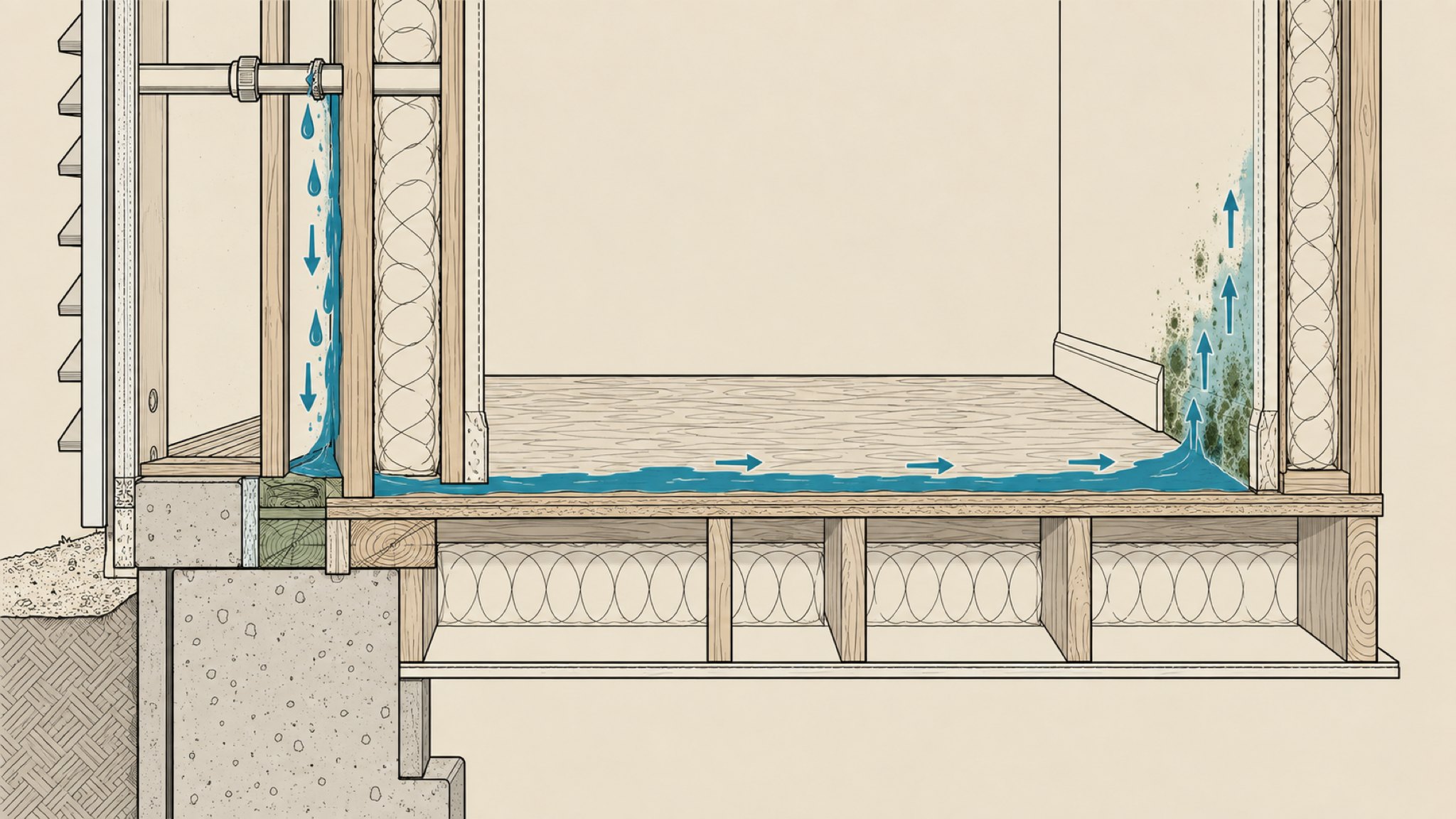
01
Where it starts
Mold is never the first event. Somewhere, water is getting where it should not be, here, a supply fitting weeping inside a wall, slowly enough that nobody notices. A cavity that stays damp for days is all it takes. Fix the moisture or the mold comes back; that is not a sales line, it is biology.
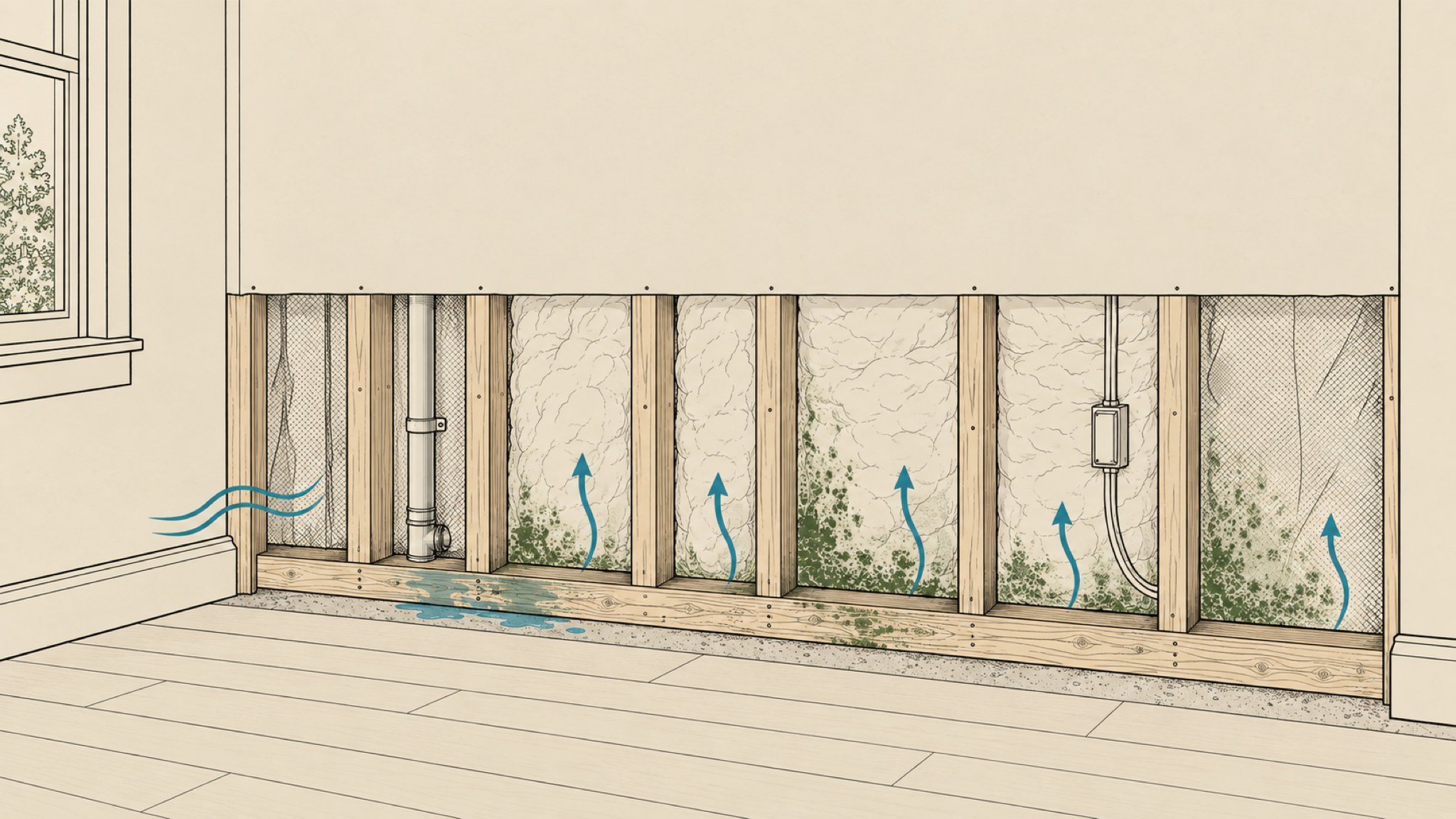
02
Growth where nobody can see it
Growth starts on the cavity side of the drywall and the framing, paper and wood, exactly what it eats. From the room, the wall looks fine. By the time there is a musty smell or a shadow on the paint, the cavity side is usually well ahead of what is visible. This is why we open walls based on moisture readings, not on what shows.
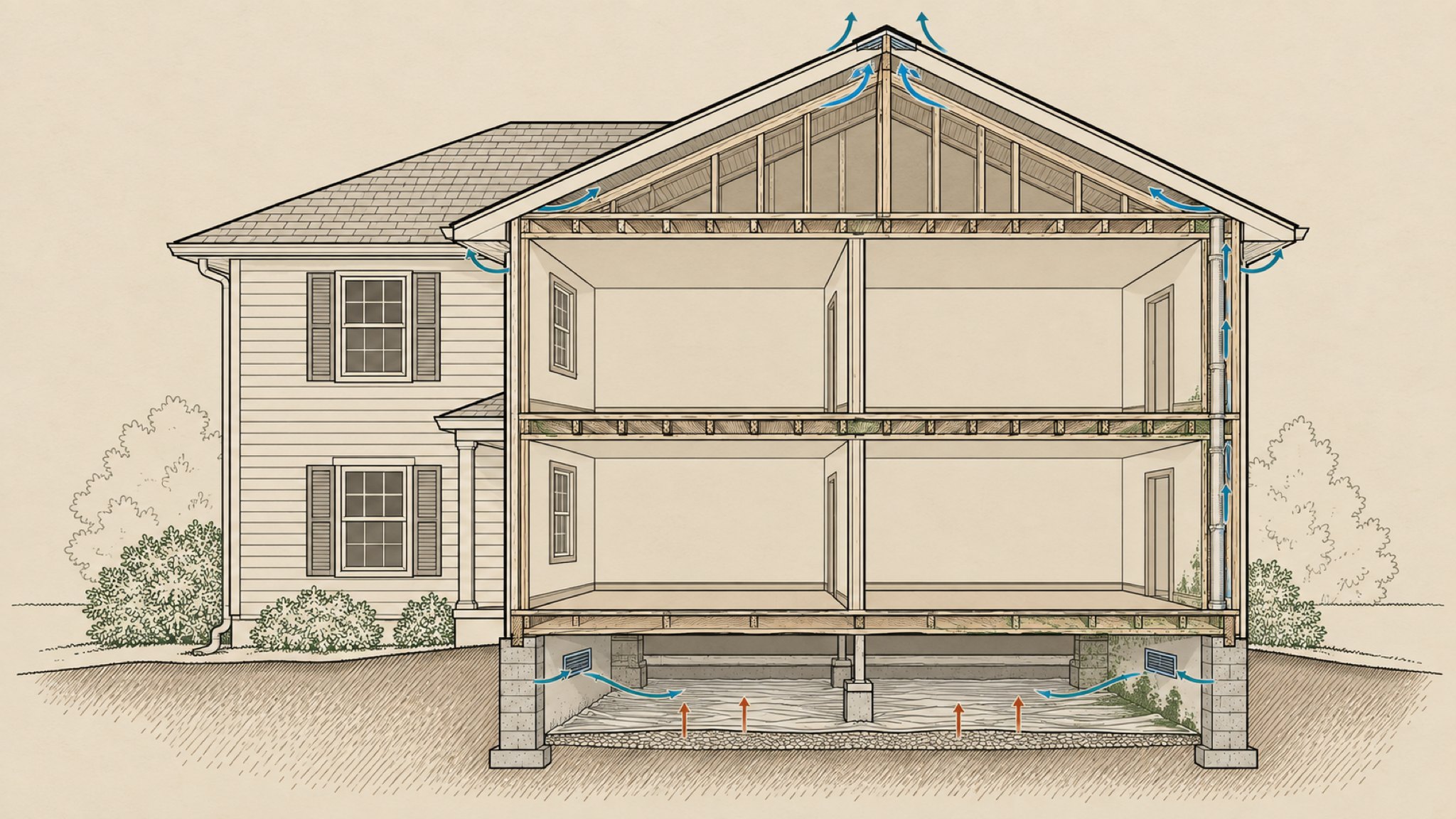
03
How spores travel through a house
Air moves through a house constantly, through outlet gaps, baseboard cracks, and every return the HVAC pulls from. Spores ride that air. A colony in one wall cavity can seed dust through the whole duct system, which is why disturbing it without controls makes a one-room problem a whole-house problem.
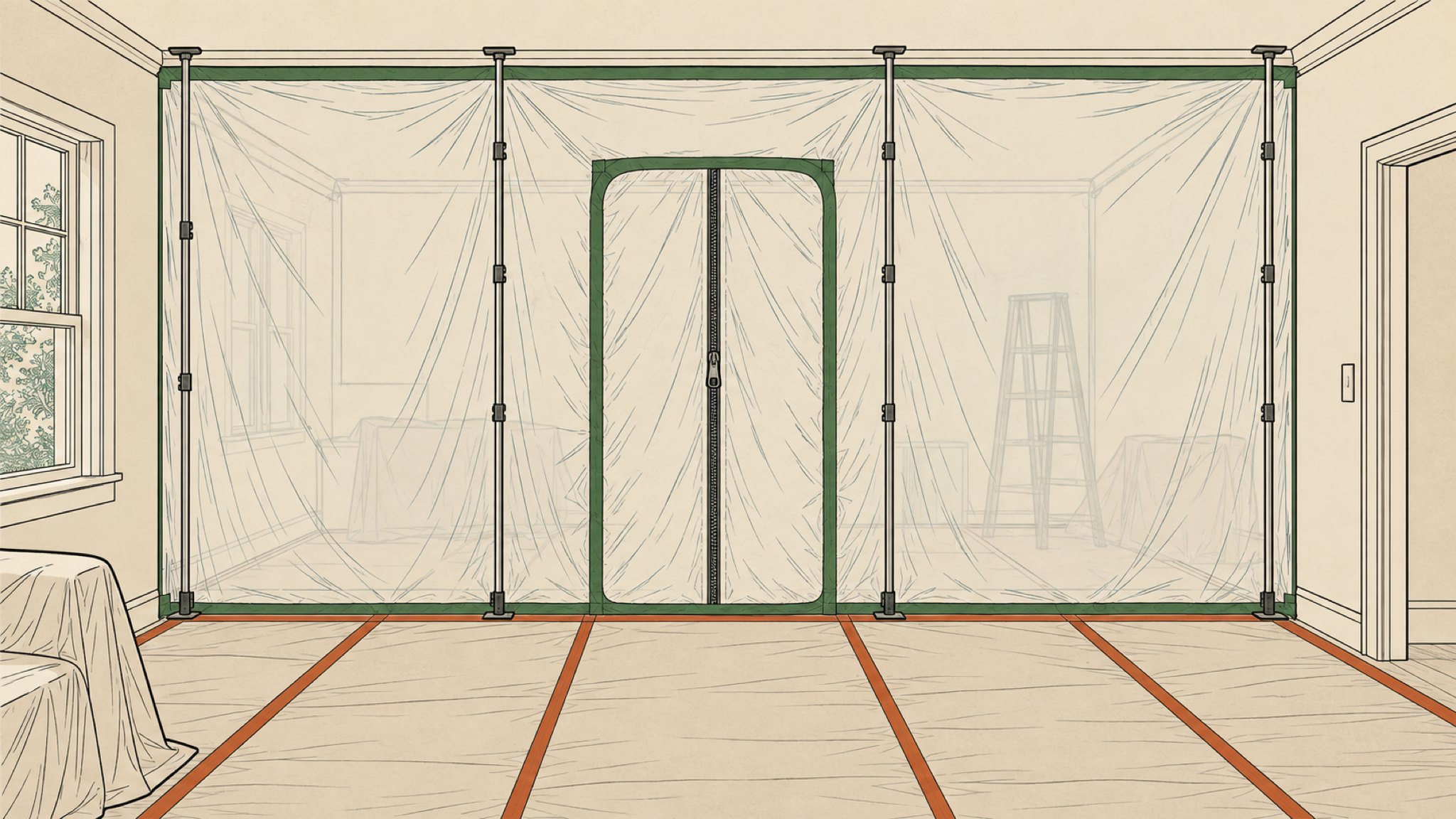
04
Containment, before demolition
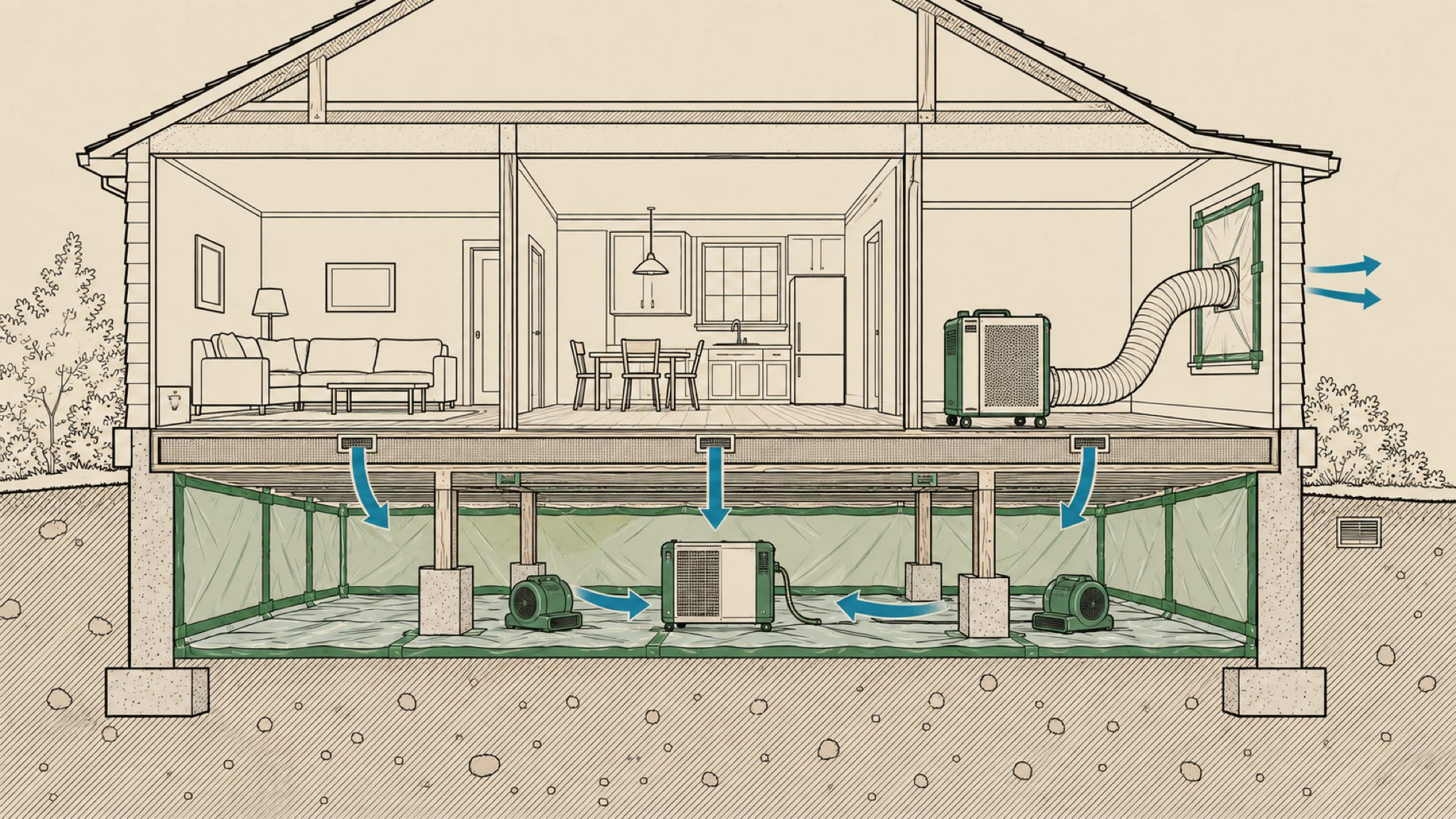
The work area gets sealed in 6-mil poly with a zipper door, taped tight, and the HVAC gets shut down with the registers sealed. Nothing gets demolished until the barrier is up. Clean containment is the difference between remediation and redistribution, it is also the easiest way to judge any contractor's work at a glance.
05
Negative air, verified
A HEPA-filtered negative air machine runs inside the containment and exhausts outside it, so air is always being pulled in through every seam, never leaking out. We verify the pressure with a manometer, not by feel. If the poly bows inward, the physics is working: whatever gets disturbed inside stays inside.
06
Removal and cleaning
Colonized drywall and insulation come out and are bagged at the wall, inside containment. Framing gets cleaned back to sound wood. HEPA vacuum, damp wipe, abrasion where it needs it. Spraying a coating over a colony does not remediate anything; it hides it, and it shows up again on the next inspection or the next humid month.
07
Clearance, then rebuild
Done means verified: the cavity dry, surfaces clean, and the air checked before the poly comes down rather than after it. Then the wall gets rebuilt. The order is the whole discipline: moisture fixed, contained, removed, verified, rebuilt. Skip a step and you paid to move the problem, not to end it.


Mold testing vs. mold inspection: which one you actually need
These are two different products and people use the words interchangeably. One finds water. The other sends a sample to a lab. Most homeowners who call asking for a test need the other one.
An inspection
- A person, a moisture meter, a thermal camera, and a hygrometer, in your house.
- Readings taken at marked locations, with a reading on a known-dry material in the same building so there is a baseline to compare against.
- The crawlspace and the attic entered, not looked at from the hatch.
- A written report with numbered photos mapped to where they were taken.
- Answers the question that decides the job: where is the water coming from, and is it still coming.
- At Peak: free gets a meter on the one spot you called about and a straight answer out loud, with nothing in writing. The $279 Full Inspection covers the whole house and ends in a written report. Both numbers are published because they are real.
A test
- Air cassettes, tape lifts, or swabs, sent to an accredited lab, with a report of what grew and in what concentration.
- Tells you what is present. Does not tell you where the water is.
- Priced by whoever takes the sample, plus the lab fee, and it varies by how many samples the protocol calls for.
- Genuinely useful in a short list of situations, and close to useless outside them.
- Peak does not do this. We refer it to independent industrial hygienists and environmental professionals in the valley who sample and do not remediate.
When a lab test is worth paying for
- There is a smell and nothing visible. Sampling, paired with an inspection, can help locate a source inside a wall or a chase.
- You need a clearance document. A sale, a lender, a property manager, or a landlord dispute often requires a piece of paper from a third party saying the work passed.
- A physician has asked for it. If a doctor treating someone in the house wants to know what is in the air, get the samples.
- There is a disagreement. Two contractors, a seller and a buyer, a tenant and an owner. A neutral sampler ends the argument faster than another opinion does.
When it is money you did not need to spend
- You are looking at growth on a joist or a bathroom ceiling. You already know it is there, and the lab result will not change what has to happen to it.
- A store-bought settle plate kit. Spores are in every building on earth, so those kits grow something in nearly every house, and the result reads as alarming no matter what it means.
- As a substitute for finding the water. A lab report with no moisture readings behind it tells you what is growing and nothing about why.
Why we refer testing out instead of selling it
IICRC S520, the mold standard the industry works to, calls for post-remediation verification by a party independent of the company that did the remediation. That is not a technicality. A remediator who samples his own work is grading his own homework, and he sets the pass line.
The same logic applies before the job. A company that requires a paid test before it will quote you, and also sells the remediation the test recommends, is on both sides of the decision. That structure produces bigger scopes. It is legal, it is common, and we do not do it.
So we do the part we are good at: find the water, put numbers on the materials, write the scope, do the removal, and document it. When a sample is genuinely called for we send you to someone who does that for a living and has no financial interest in the answer. You hire them directly and the report is yours.
Free covers the one spot you called about: a meter on the material, humidity in the room, a straight answer before we leave, and nothing in writing.
The $279 Full Inspection covers the whole house, every instrument, and a written report in your portal that is yours whether or not you hire Peak.
Mold on floor joists and subfloor
Dark joists, dark subfloor, and a photograph that cannot settle it. This is the most common thing we get sent a picture of. Dark wood under a house or on the underside of a roof deck can be active growth, dead growth that left its color behind, or something that was never mold at all.
Mold pigments soak into wood fiber. When growth dies, whether from drying out or from being cleaned, the color often stays. That is why a crawlspace that was remediated four years ago can still look bad in a listing photo, and why a homeowner who cleaned a joist with a brush and a spray bottle sees no difference and assumes it failed.
It also runs the other way. Wood can look nearly clean and still be colonized in the grain, which is why cleaning is a physical process rather than a wipe with a chemical.
The thing that separates the two is not visual. It is a moisture meter, a probe, and knowing what the space has been doing seasonally. In this valley that means asking what the crawlspace looked like in May, when the canals have been charged a month and the water table is at its high point, rather than what it looks like in October.

Dark wood that is not mold at all
Efflorescence.
A white or gray crust on a stem wall, a pier, or a block foundation. It is mineral salt left behind when water moved through concrete and evaporated. It is not a living thing. It does mean water has been moving through that wall, which is worth chasing.
Old water staining.
A tan or brown tide line with hard edges, usually on the subfloor or on framing under a fixture. It records a leak that happened. Whether it is still happening is a meter question.
Mineral or tannin bleed.
Dark streaks running down from a nail plate, a joist hanger, or a fastener. That is rust and wood tannin reacting, not growth.
Overspray from a previous treatment.
Old whitewash, a borate treatment, or an encapsulant sprayed over growth years ago. It reads as a strange uniform tone that stops in a straight line where somebody stopped spraying.
Soot and dust.
Common in crawlspaces under houses with a wood stove, and in attics near an old chimney chase. It smears rather than sits in the grain.
Sapstain and blue stain in the lumber itself.
Some framing arrives at the site already discolored from how the lumber was stored at the mill. It is in the wood, it predates the house, and it is not going anywhere.
How we decide, on site
Put a meter on it.
Framing in a dry crawlspace in this valley typically reads somewhere in the single digits to mid teens for moisture content. Sustained readings well above that mean the space is still wet, and that is the problem to solve before anyone talks about cleaning.
Probe it.
Push a screwdriver or an awl into the bottom edge of a joist with normal hand pressure. Sound wood stops it. If the tip sinks, that is rot, and rot is a framing repair by a carpenter, not a remediation scope. Cleaning a rotted joist does nothing useful to it.
Look at where it is, not just what color it is.
Growth follows air and moisture. It concentrates at the perimeter, in corners, behind ductwork, under bathrooms and kitchens, on the north side, and at the far end from the access hatch. Uniform discoloration everywhere including the dry, well-ventilated middle is more likely to be something the lumber came with.
Ask what season it is.
A crawlspace inspected in February and the same crawlspace in late May can be two different buildings here. The canals charge in early April and the shallow water table comes up with them. A dry reading in winter is not a clean bill of health on a lot near a lateral.
What we will and will not do about the color
Cleaning removes the growth. It does not always remove the color, and any company that promises you bright new lumber has not looked at your joists.
There are four honest options and we price them as separate lines so you can choose, rather than discovering later what was and was not included.
- HEPA vacuum and damp wipe. Removes surface growth and most loose material. Leaves pigment that is in the grain. This is the baseline on every job.
- Sanding. Takes the top layer of wood fiber off, which takes most of the color with it. Slow, dusty, and priced by the square foot of framing, so it is normally reserved for the areas a buyer's inspector will photograph.
- Media blasting. Soda or dry ice, driven at the wood. It is the fastest way to get a large crawlspace or an attic deck back to clean wood, it makes a significant mess that has to be contained and cleaned up, and it costs more than wiping.
- A stain-lightening product on cleaned wood. It reduces the remaining color. It is cosmetic, it works on some woods better than others, and it is not remediation. We will tell you before we start whether we expect it to help on your framing.
For a sale, what actually matters to the other side is a moisture reading and, when it is required, a clearance report from an independent inspector. Not the shade of the plywood. We have watched sellers spend real money making a crawlspace photogenic when the buyer's lender wanted a document instead.
Where the musty smell comes from
A large share of the calls that start with "we smell mold" turn out to be ground moisture under the floor, moving up into the house on the same air current that carries the heat out of it. Where you notice it and where it is actually coming from are usually two different rooms.
The smell is real. What people are smelling are the volatile compounds mold gives off while it grows, and the human nose is good at them at very low concentrations. That is why you can smell a problem you cannot see, and why the smell often shows up long before anything is visible.
In a Treasure Valley house the path is usually the same. Damp soil under the floor gives off vapor around the clock. Warm air leaves the top of the house in winter, and replacement air is pulled in at the bottom, which is the crawlspace. That air travels up through plumbing chases, wire penetrations, and every gap in the floor assembly, and it arrives in the hallway. That is why the smell is worst in January in a house where nothing is leaking.
The HVAC system is the other distributor. In a lot of homes here the ductwork, and sometimes the air handler and a return, sit in the crawlspace. A disconnected duct or a return leak pressurizes the crawl or pulls crawl air directly into the supply. Then the smell arrives in the first thirty seconds after the system kicks on, from a vent, in a room with nothing wrong with it.
The smell is worst in January in a house where nothing is leaking.
Where to look, in order
The crawlspace, first, every time.
Torn or missing vapor barrier, damp or dark soil, a water line on the piers, condensation on the ductwork, insulation sagging or falling. This is the answer more often than anything else on this list.
The supply and return registers.
If the smell comes on with the system and fades when it cycles off, the duct system is carrying it. That points at the crawlspace or a wet return chase, and duct cleaning alone does not solve it if the source is still upstream.
Under the bathroom, under the kitchen sink, and behind the dishwasher.
Slow leaks in cabinets are quiet for a long time. Particleboard cabinet bottoms swell before they smell, and the smell arrives after the material is already gone.
The bath fan, and whether it goes anywhere.
A fan that dumps into the attic makes the attic wet and pushes odor back down through the ceiling and the can lights. It is also the single most common cause of attic growth in this valley.
An evaporative cooler, in the spring.
Coolers on the Bench, in Garden City, and out toward Mountain Home get charged in May and drained in October. A pan or a float valve that leaked while nobody was watching leaves a wet duct chase and a smell that arrives with the first warm week.
A basement, if you have one.
Finished basements are rarer here than in most of the country and concentrated in a few areas. Where they exist, carpet against a below-grade wall with no capillary break is a reliable smell source.
The washing machine, the dishwasher gasket, and a floor drain that dried out.
Not everything musty is a building problem. A dry trap on an unused floor drain lets sewer gas into the room, and that reads as musty to most people. Run water down it and see if the smell changes in a day.
The order that saves money: find the water before you buy an air purifier, an ozone machine, or a duct cleaning. All three are useful on the right job and none of them do anything about wet soil under your floor.
Where mold grows in Treasure Valley houses
The building stock and the water calendar here produce a specific short list. It is not the same list you would write in Seattle.
Crawlspaces, on the joists and the underside of the subfloor.
This is the big one. Most homes in this valley sit over a vented crawlspace on soil. Gravity irrigation charges the canals and laterals in early April, the shallow water table comes up with it, and crawls that were dry all winter can take standing water in May with nothing leaking anywhere in the house. Add a torn vapor barrier and you have a permanent vapor source under the floor.
Attics, on the underside of the roof sheathing.
Warm house air leaks up through the hatch, the can lights, and any bath fan that dead-ends in the insulation, then frosts on sheathing that is below freezing in January. The frost melts in late February and the deck stays wet for weeks. Summer attics here are hot and dry. The damage is done by spring.
Bathroom ceilings and the wall behind a shower surround.
A fan that is undersized, disconnected, or vented into the attic leaves the moisture in the room. Then it condenses on the coldest ceiling in the house, usually the one under an unconditioned attic.
Behind and under kitchen appliances.
Dishwasher supply lines, fridge ice-maker lines, and disposal connections leak slowly into cabinet bases and under flooring. Nobody sees it until the floor moves or the smell arrives.
Around and under evaporative coolers.
Roof-mounted and window units on the Bench, in Garden City, in Old Nampa and Caldwell, and out toward Mountain Home. Spring startup and fall drain-down are both leak events, and the water lands in a duct chase or on a ceiling.
Window frames and exterior wall corners in winter.
Older single-pane and early double-pane windows in the North End, the Bench, Old Nampa, and downtown Caldwell run below the dew point of the room air in January. The water condenses, runs down the frame, and sits on the sill and the drywall corner.
Finished basements, where they exist.
Concentrated in Eagle, parts of the Boise foothills, some Caldwell stock, and the mountain towns. Carpet and pad against a below-grade wall, a partial basement with no perimeter drain, or a sump that failed while the family was on vacation.
Inside the ductwork and around the air handler.
Where the system lives in the crawlspace, the ducts run through the moisture. A leaking return pulls crawl air in. A condensate line that terminates in the crawl instead of outside it puts a summer's worth of water on the soil, six feet from the equipment.
Garages and shops on the water heater wall.
Water heaters here are commonly in the garage. A tank that has been weeping at a fitting for months soaks the drywall behind it and the bottom plate, and the sheetrock in a garage is often unfinished on the back side.

Idaho has no mold license, and what to check instead
This is worth knowing before you hire anyone, including us. It is not a scandal and it is not an accusation. It is the legal situation, and most homeowners assume the opposite.
Idaho has no state license for mold assessment or mold remediation. There is no state mold statute setting a cleanup standard, no state certification a remediator has to hold, and no state agency that inspects the work when it is done. The Department of Health and Welfare maintains a mold page for the public and is clear that it does not test homes and does not certify companies.
In practice that means anyone in this state can put "mold specialist" on a truck and answer the phone tomorrow. Some of the companies working here hold real certifications they were never required to get, carry the right insurance, and do careful work. Others are a website, a phone number, and a subcontractor. Nothing in Idaho law distinguishes between them for you.
There is one thing the state does require and it is worth using: contractors doing this kind of work register with the Idaho Contractors Board, and that registration number is public and checkable. Ours is RCE-67387. A company that will not give you a number, or gives you one that does not come back to their business name, has told you something.
What to check instead
- An Idaho contractor registration number you can look up. Registration is not a mold credential, but it means there is a real registered business with a verifiable name behind the truck. It takes two minutes to check.
- IICRC training, and specifically to the S520 standard. S520 is the mold standard the industry actually works to, and the one insurance carriers and hygienists reference. Ask which technicians hold it, not whether the company has a logo on the website. Certifications belong to people, not to companies.
- General liability insurance, and ask about pollution coverage. Many general liability policies exclude mold, sometimes called a fungi or bacteria exclusion. A remediation company should be able to tell you plainly whether their policy responds to this work. Ask for the certificate.
- Whether they put a meter on the material before they price it. This is the fastest sorting question in the trade. A scope written without moisture readings is a guess with a dollar sign on it. If someone quotes a crawlspace from the hatch or an attic from the driveway, get another bid.
- Whether they refer clearance testing to an independent party. S520 asks for post-remediation verification by someone independent of the remediator. A company that samples its own work and issues its own pass is grading its own homework. So is a company that requires a paid test up front and also sells the remediation it recommends.
- A written, line-item scope before anyone starts. Square footage, materials, containment, equipment days, and what is excluded. "Mold remediation, one lump sum" is not a scope, and it is impossible to compare against another bid or for an adjuster to read line by line.
- Photos and readings in the report, mapped to locations. A report you can check is a report you can hand to a buyer, a lender, or an adjuster. A report that is three paragraphs and a total is a receipt.
- How they talk about warranties. Some companies in this market advertise long no-regrowth warranties. Ask what voids it. Mold comes back when water comes back, and a warranty that excludes any new moisture event is a warranty on the weather.
Idaho Contractors Board RCE-67387. IICRC certified, trained to the S520 mold standard. We put a meter on the material before we price it, we write a line-item scope you read before anyone starts, and we refer clearance sampling to an independent inspector.
Bleach, dry fog, and the other shortcuts
Every one of these does something. None of them does the thing people buy them for, which is make the mold gone and keep it gone.
Bleach on drywall or framing.
Household bleach is mostly water with a small percentage of sodium hypochlorite. On a hard, non-porous surface like tile, glass, or a tub surround it works. On drywall paper, framing, or insulation it strips the color off the surface, leaves the growth in the material underneath, and adds water to the exact substrate that has been feeding it. It looks fixed for about a month. The EPA stopped recommending bleach as a routine mold cleanup for homeowners years ago for essentially this reason.
Vinegar and hydrogen peroxide.
Better than bleach on some surfaces and much less aggressive to the material. Same fundamental limitation: a liquid applied to the surface of a porous material does not remove what is inside it. Fine for a small patch of surface growth on a hard surface after the water is fixed. Not a remediation.
Dry fog and "no demolition" mold removal.
Fogging disperses a fine aerosol of a registered antimicrobial through a space. It reaches surfaces and cavities a person cannot, and it will kill organisms it contacts. What it does not do is remove anything. The dead growth and the material it grew in stay where they are, and porous material that has been colonized stays colonized whether the organisms in it are alive or not. It also does nothing about the water. S520 treats remediation as the removal of contamination rather than killing it in place, which is why a fogging-only scope is difficult to verify with a post-remediation inspection. Fogging has a legitimate role as a supplemental step after physical removal, particularly in cavities and contents. Sold as a replacement for removal, it is a cheaper job that leaves the material in the building.
Ozone generators.
Ozone is a strong oxidizer, and it is used in the restoration trade for odor on unoccupied structures under controlled conditions. It is a lung irritant at the concentrations required to do anything, which is why it is never run in an occupied space. It does not remove mold, and it does not reach inside a wall cavity or into the grain of a joist.
Painting or sealing over it.
Mold-resistant primer over growth hides it until the paint bubbles or the material fails. It also becomes a disclosure problem at sale, and a buyer's inspector with a moisture meter finds it in a walk-through. Encapsulants have a real use on cleaned wood in an inaccessible space. Over live growth they are a countdown.
Air purifiers as a solution.
A true HEPA unit does reduce airborne particulate while it runs, and we run air scrubbers on every job for exactly that reason. It captures what is already in the air. It does not touch what is growing on a joist, and the moment the source releases more, the unit is behind again. Useful during and after remediation. Not a substitute for it.
Crawlspace and attic "mold bombs", foggers, and killer sprays from the hardware store.
Two problems. First, they wet the space, which in a damp crawlspace or a frosting attic is the opposite of the goal. Second, applying them means disturbing colonized material without containment or negative air, which pushes spores up into the living space through the same paths that carry the smell. If the area is small, the material is hard, and the water is genuinely fixed, cleaning it yourself is reasonable. Spraying a wet crawlspace grows it back.
Fogging kills what it touches and removes nothing.
How mold remediation is actually priced
Nobody in this market can give you a real number over the phone, and the ones who do are quoting a range wide enough to be meaningless. Here is what the number is built from, so you can read a bid instead of guessing at it.
Mold work is priced the way insurance restoration is priced: by line item. Square feet of affected material, linear feet of containment, each piece of equipment per day, labor by trade and hour, disposal by the load. Most of the industry writes it in Xactimate, which is the estimating platform carriers work in, and we do too, whether or not there is a claim.
That matters to you for one reason. A line-item estimate can be compared to another line-item estimate and read line by line by an adjuster. A lump sum cannot be compared to anything.
What the number is built from
How much material is affected, and whether it is porous.
The biggest driver by a wide margin. Porous material comes out and goes back: drywall, insulation, carpet and pad, particleboard, ceiling tile. Semi-porous framing gets cleaned in place. A ten square foot patch of drywall and a whole crawlspace footprint of joists are different orders of magnitude, and the second one has no drywall in it at all.
Whether it is wet right now.
Wet means drying equipment, daily monitoring visits, and a longer job before any cleaning starts. It also means the source has to be solved, and that is frequently a separate trade.
Containment: how many zones, and how big.
Poly, framing for the barrier, zippered entries, sealing the HVAC penetrations, and a negative air machine per zone. A single bathroom is one small containment. Three rooms on two floors is a different build and a different number of machines.
Access.
An eighteen-inch crawlspace on the Bench and a five-foot crawl in a newer Meridian subdivision are the same square footage and not the same day. A walk-up attic and a scuttle hole over a bedroom closet are not the same job either. Access is the driver homeowners are most often surprised by.
Whether the color has to come off, and how.
HEPA vacuuming and damp wiping is the baseline. Sanding or media blasting to bare wood is a separate line, priced by area, and it is the difference between a clean crawlspace and a photogenic one.
Equipment days.
Air scrubbers, negative air machines, dehumidifiers, and air movers are billed per unit per day. A job that runs five days instead of three because the source was not fixed first costs more in equipment than in labor.
Source correction.
The vapor barrier, the drainage and sump, the bath fan ducted outside, the baffles, the plumbing repair, the roof. Some of that is ours and some belongs to a plumber, an HVAC contractor, or a roofer. It is a separate line either way, and skipping it is why mold jobs get done twice.
Third-party clearance, when it is required.
Billed by the independent inspector who takes the samples, not by us. Ask them for the number directly. Build in lab turnaround time if you are working against a closing date.
The rebuild.
Remediation ends at clean, dry, and verified. Putting drywall, texture, paint, trim, and flooring back is a separate scope with a separate number, and it should be quoted separately so you can see both.
The numbers we do publish
Free is the one spot. A certified technician comes out to the area you called about, puts a moisture meter on it, reads temperature and relative humidity, and gives you a straight answer before leaving. No charge, no obligation, and nothing in writing.
The Full Inspection is $279. That is the whole house: instruments, moisture mapping, thermal imaging, crawlspace and attic, and a written report with numbered photos in your portal. If the visit turns into a covered claim, the fee goes on the estimate as the emergency service call, which is the carrier's line rather than yours.
Everything past that gets a written line-item scope after somebody has been in the building and put a meter on the material. We will tell you on the phone what the drivers look like for your situation. We will not give you a remediation price over the phone, because the honest version of that number does not exist yet at that point in the conversation.
When insurance is involved, and when it is not
Coverage follows the cause of the water, not the mold. That one sentence resolves most of the confusion.
Mold that results from a sudden, accidental, covered water loss is often covered, usually up to a mold sublimit written into the policy. Mold that grew because a crawlspace has been damp for nine years, because a bath fan was never ducted outside, or because a supply line dripped for eight months is generally treated as maintenance and excluded.
Ground water is its own category and it is the one that catches people in this valley. Water that comes up through the soil is flood under essentially every standard homeowner policy, and flood is excluded. That is the irrigation-season crawlspace, and we say so on the first phone call rather than at the end of the job.
We are the contractor, not the carrier and not a public adjuster. What we control is the file: what was wet, what it took to fix, what it cost, and an honest statement of the cause. A claim built on the wrong cause of loss falls apart later, usually at the worst moment.
If you need the work done
Three scopes, and which one you need is a location question. Every city we serve has its own page for each of them.
Questions we get about mold
Is black mold dangerous?
Not in a way that changes what happens next. "Black mold" is a common name, usually for Stachybotrys, and color does not identify a species. The CDC's position is that the type does not need to be identified, because all indoor mold is removed the same way: find and fix the water, contain the area, remove affected porous material, HEPA clean what stays, and verify it is dry. What changes the job is how much material is affected and whether it is still wet. If someone in the house has symptoms, that is a conversation for their doctor, not for a contractor.
Do I need a mold test or a mold inspection?
If you can see growth, an inspection. You already know the mold is there, and a lab result will not change the removal scope. An inspection with a moisture meter and a thermal camera finds the water, which is the part that decides the job. Lab sampling earns its cost when you smell mold and cannot find it, when a sale or a lender needs a clearance document, when a physician has asked for it, or when there is a dispute. In those cases hire an independent sampler, not the company doing the removal.
Does Peak do mold testing?
No. We do not take air or surface samples and we do not clear our own work. IICRC S520 calls for post-remediation verification by a party independent of the remediator, and we think that is right. When sampling is genuinely called for we refer you to independent industrial hygienists and environmental professionals in the valley who sample and do not remediate. You hire them directly and the report is yours.
Do mold stains on wood mean there is still active mold?
Not necessarily. Mold pigment soaks into wood fiber and stays after the growth dies, so a joist that was remediated or simply dried out years ago can still look dark. It also runs the other way: wood can look nearly clean and still be colonized in the grain. A moisture meter and a probe settle it. Dry, sound framing with discoloration on it is a cleaning question and a schedule item. Wet framing is an unsolved moisture problem.
Is mold in a crawl space a problem, or is it normal in Idaho?
Common is not the same as fine. Most crawlspaces in this valley have some growth on the framing, because most of them sit on damp soil under a torn or missing vapor barrier and the water table comes up when the canals charge in April. Crawlspace air becomes house air through the stack effect, strongest in winter, so what is down there is in the hallway too. A small area on dry framing is maintenance. Growth across the footprint, wet wood, or ductwork running through it is a job.
What causes a musty smell in the house when nothing is leaking?
Usually ground moisture under the floor. Damp soil in a crawlspace gives off vapor continuously, and warm air leaving the top of the house pulls that crawlspace air up through plumbing chases and floor penetrations into the living space. It is strongest in winter, when the indoor to outdoor temperature difference is largest. If the smell arrives in the first thirty seconds after the furnace or the air conditioner starts, the duct system is carrying it, which points at the same place.
Does bleach kill mold on drywall or wood?
Not usefully. Bleach is mostly water. On a hard, non-porous surface like tile or a tub surround it works. On drywall, framing, or insulation it takes the color off the surface, leaves the growth in the material, and adds water to the exact substrate feeding it. Porous material with mold in it has to be physically removed, and semi-porous framing has to be cleaned rather than sprayed.
Does dry fog or no-demolition mold removal work?
Fogging disperses an antimicrobial aerosol that reaches surfaces and cavities a person cannot, and it kills organisms it contacts. It does not remove anything. The dead growth and the colonized material stay in the building, and porous material that has been colonized stays that way whether the organisms are alive or not. It also does nothing about the water. S520 defines remediation as removing contamination, not killing it in place. Fogging has a real role as a supplemental step after physical removal. As a replacement for removal, it is a cheaper job that leaves the material where it was.
Does Idaho require a mold license?
No. Idaho has no state license for mold assessment or remediation, no state cleanup standard, and the Department of Health and Welfare does not test homes or certify companies. Anyone here can advertise mold work. What you can check instead: an Idaho Contractors Board registration number that comes back to the business name, IICRC training to the S520 standard held by the technicians on the job, general liability insurance that actually responds to mold work, whether they put a meter on the material before pricing it, and whether they refer clearance testing to an independent party. Ours is RCE-67387.
How much does mold remediation cost?
It is priced by line item, not by the room. The drivers are how much material is affected and whether it is porous, whether it is wet right now, how much containment the job needs, how hard the space is to work in, how many equipment days it runs, and what it takes to correct the source. We publish the two numbers that are real up front: the visit to the one spot you called about is free, and the whole-house Full Inspection is $279. A remediation number comes after someone has been in the building with a meter, in writing, before anyone starts work.
How much does a mold inspection cost in Boise?
Free covers one spot. A certified technician comes to the area you called about, meters it, reads the humidity in that room, and tells you what they find before they leave. Nothing in writing. The $279 Full Inspection covers the whole house: moisture mapping at marked points, thermal imaging, the crawlspace and the attic entered, and a written report with numbered photos you can hand to an agent, a lender, or an adjuster. Third-party lab sampling, if you need it, is billed separately by the independent inspector who takes it.
Can I stay in the house during mold remediation?
Usually. Containment and negative air exist so the rest of the house stays usable while the work happens. A bathroom, a closet, an attic, or a crawlspace almost never requires anyone to leave. We will tell you plainly if a job is large enough or central enough that staying is impractical, and if someone in the house is immunocompromised or has significant asthma, that is a conversation to have with their physician before the work starts.
How long after water damage does mold start growing?
Roughly 24 to 48 hours on wet organic material at normal indoor temperatures. That is why the response to a water loss is drying, immediately, with readings that prove it dried. It is also why a leak that sat behind a cabinet for a month is a mold job by the time anyone sees it, and why what you are looking at has been wet longer than it looks.
Related
Describe what you found
A person answers 24 hours a day. Send a photo, tell us what the room smells like, and we will tell you what the next step is, including when the next step is not us.