
24/7 Water Damage Restoration in Nampa, ID
Extraction, structural drying, and daily moisture readings until wet materials match the dry standard in the rest of the building. IICRC S500. Licensed RCE-67387.
- 24/7 emergency response
- IICRC certified · RCE-67387
- Locally owned · 10 years
A person answers 24 hours a day
Dispatching to Nampa within about an hour.
Call Now: (208) 391-5248Arrival windows are estimates from our South Nampa dispatch, not guarantees. Call and we’ll give you a real time for your address.
What the work involves
The actual scope, in the order it matters. If a step is missing from someone’s bid, ask them why.
- Emergency extraction of standing water from carpet, pad, hard surfaces, and wall cavities.
- Water category assessment: Category 1 clean, Category 2 gray, Category 3 black. The category decides what dries in place and what has to be removed.
- Thermal imaging and moisture mapping to find water behind walls, under cabinets, and in the subfloor before it becomes a mold call.
- Controlled demolition of materials that will not dry: wet fibrous insulation, saturated carpet pad, swollen baseboard, laminate flooring.
- Structural drying with air movers and LGR dehumidifiers sized by calculation to the affected class, not by habit.
- Psychrometric drying logs, numbered photos, moisture maps, and an Xactimate estimate your adjuster can review.
Some of these do not need us. A cup of water on tile, a hard-surface spill caught in the first few minutes, a sink that overflowed onto a vinyl floor: wipe it, put a fan on it, and check the baseboard tomorrow. Describe it on the phone and we will tell you which one you have before we send a truck.
How the job runs
The same sequence on every loss. Knowing what happens next is most of what makes the first day survivable.
Inspection and moisture mapping
We find every wet material, not just the visible ones. Penetrating and non-penetrating meters plus thermal imaging locate water in wall cavities, under flooring, and behind cabinets. We mark the boundary of the affected area so there is a record of what was wet on day one.
Category and class
Category describes how contaminated the water is. Class describes how much material is wet and how fast it will give the water up. Together they set the scope: what gets dried in place, what gets removed, and how much equipment the job actually needs.
Extraction
Standing water and water held in carpet and pad comes out first. Extraction removes far more water per hour than any dehumidifier, so it happens before equipment goes in rather than after.
Equipment set and structural drying
Air movers and low-grain refrigerant dehumidifiers are placed against the affected square footage and the material types involved. Containment goes up where closing off a smaller volume of air will dry it faster. Every unit is labeled and logged.
Daily monitoring
We come back every day equipment is running, take readings at the same marked points, and log temperature, relative humidity, and grains per pound. If a material stalls, the equipment changes that day. You can see the same readings on your job page as we take them.
Dry standard and demobilization
Drying is finished when the wet materials read the same as unaffected materials of the same type in the same building, not when the equipment has run a set number of days. Then we pull equipment and hand off the complete log.
A person answers 24 hours a day.
Where the water actually goes
The puddle is the part you can see. This is the rest of the path, and why surface cleanup alone leaves a structure wet.
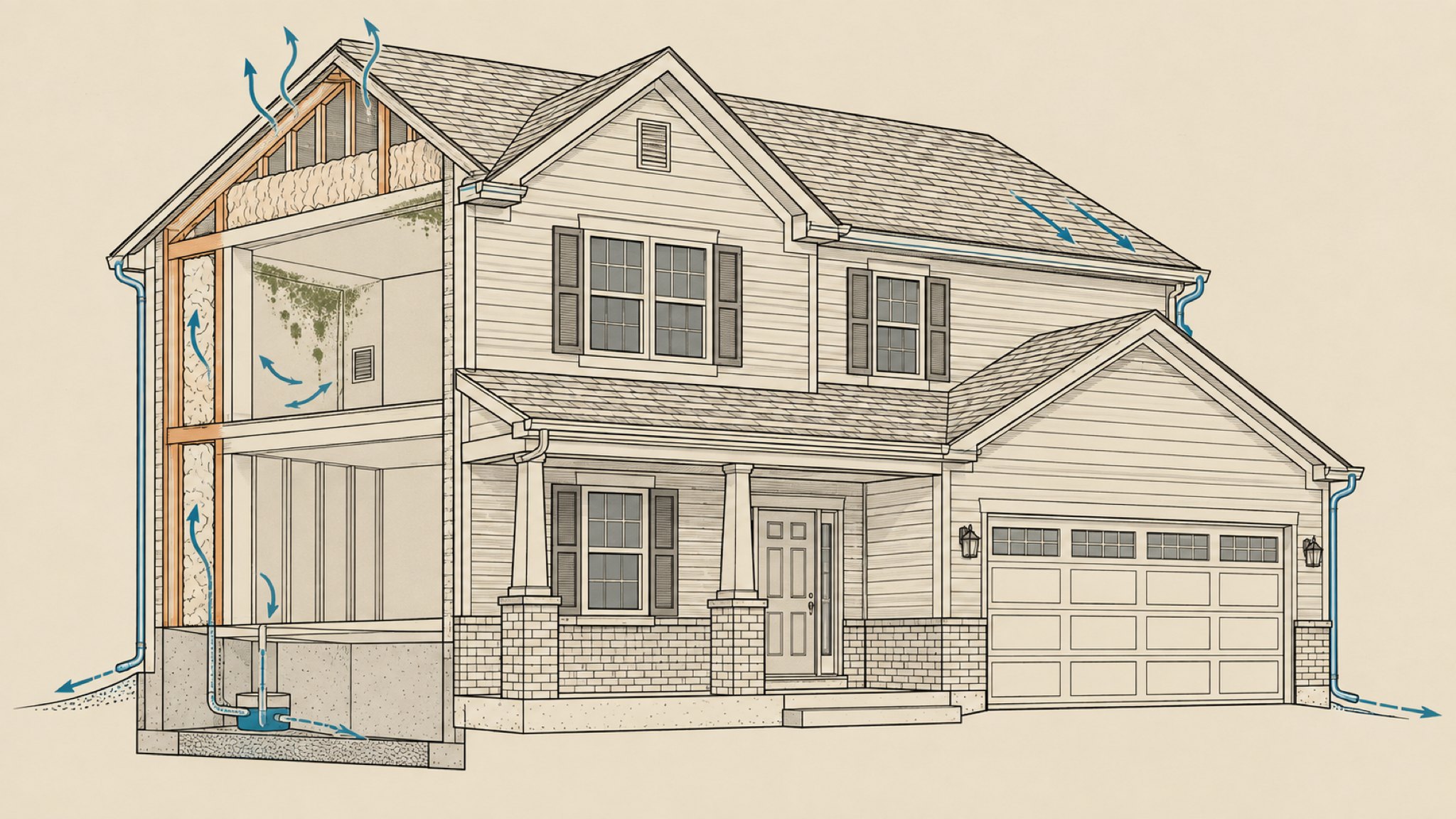
01
It starts small
Most losses start in one of two places: a supply line inside a wall, or the roof. A supply line is pressurized, so it keeps flowing until someone closes a valve, overnight, that is a lot of water. This one let go inside the upstairs bathroom wall. Nothing is visible from the room yet.
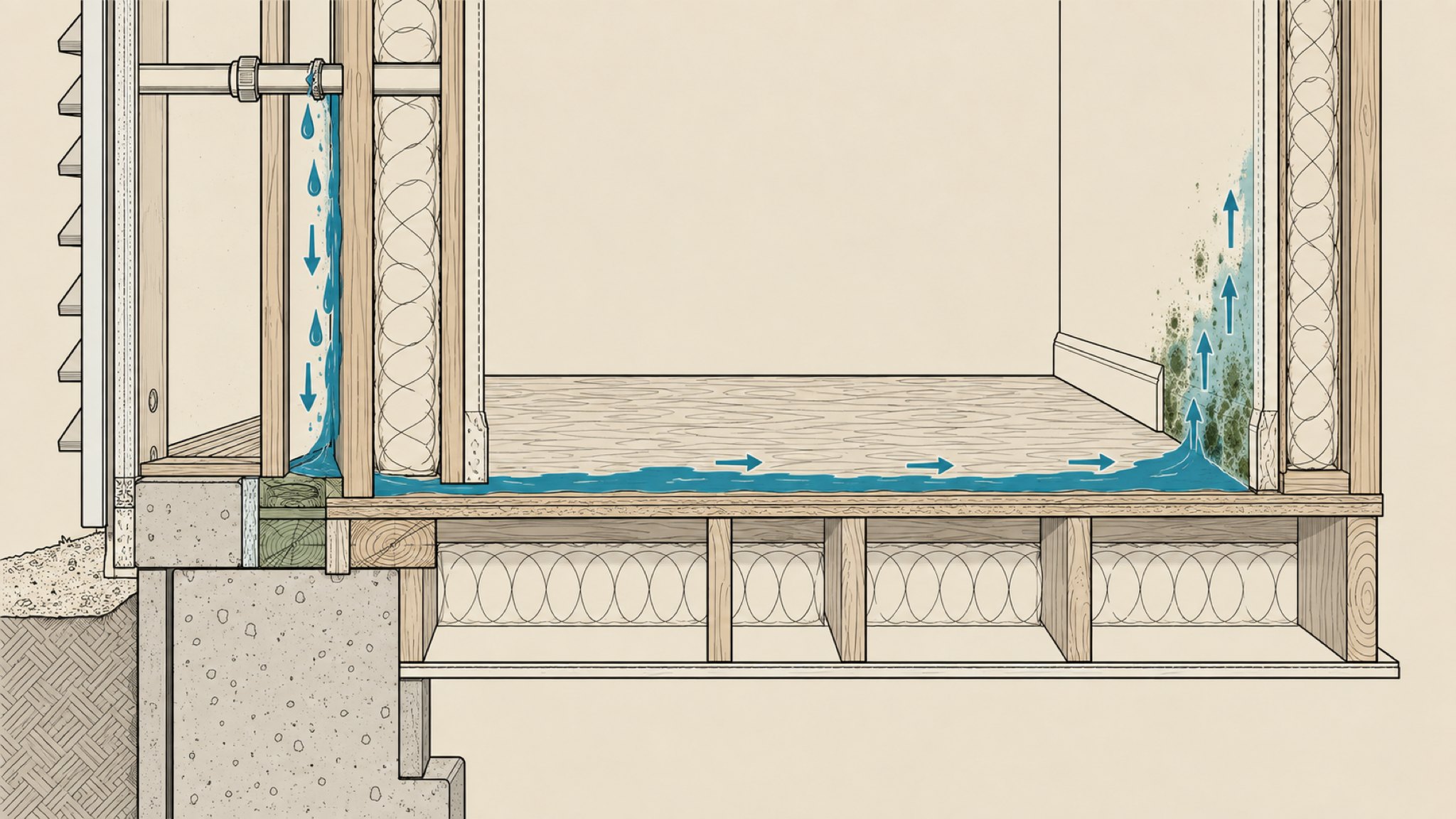
02
The part you can see
Water spreads across the floor and finds every seam in the flooring and every gap at the wall within minutes. The puddle is the part everyone finds first, and it is only the water that has not gone anywhere yet.
03
It goes down
Gravity pulls it through the subfloor into the joist bay, and from there into the ceiling below. A stain on a first-floor ceiling usually means the bay above it has been holding water for a while. A sagging ceiling is holding water right now, do not stand under it.
04
It also goes up
Drywall wicks. Standing on a wet floor, it pulls water upward, often 12 to 24 inches, behind the baseboard, where the wall looks and feels dry from the room. The visible waterline and the actual waterline are not the same line, which is why walls get mapped with a moisture meter instead of eyes.
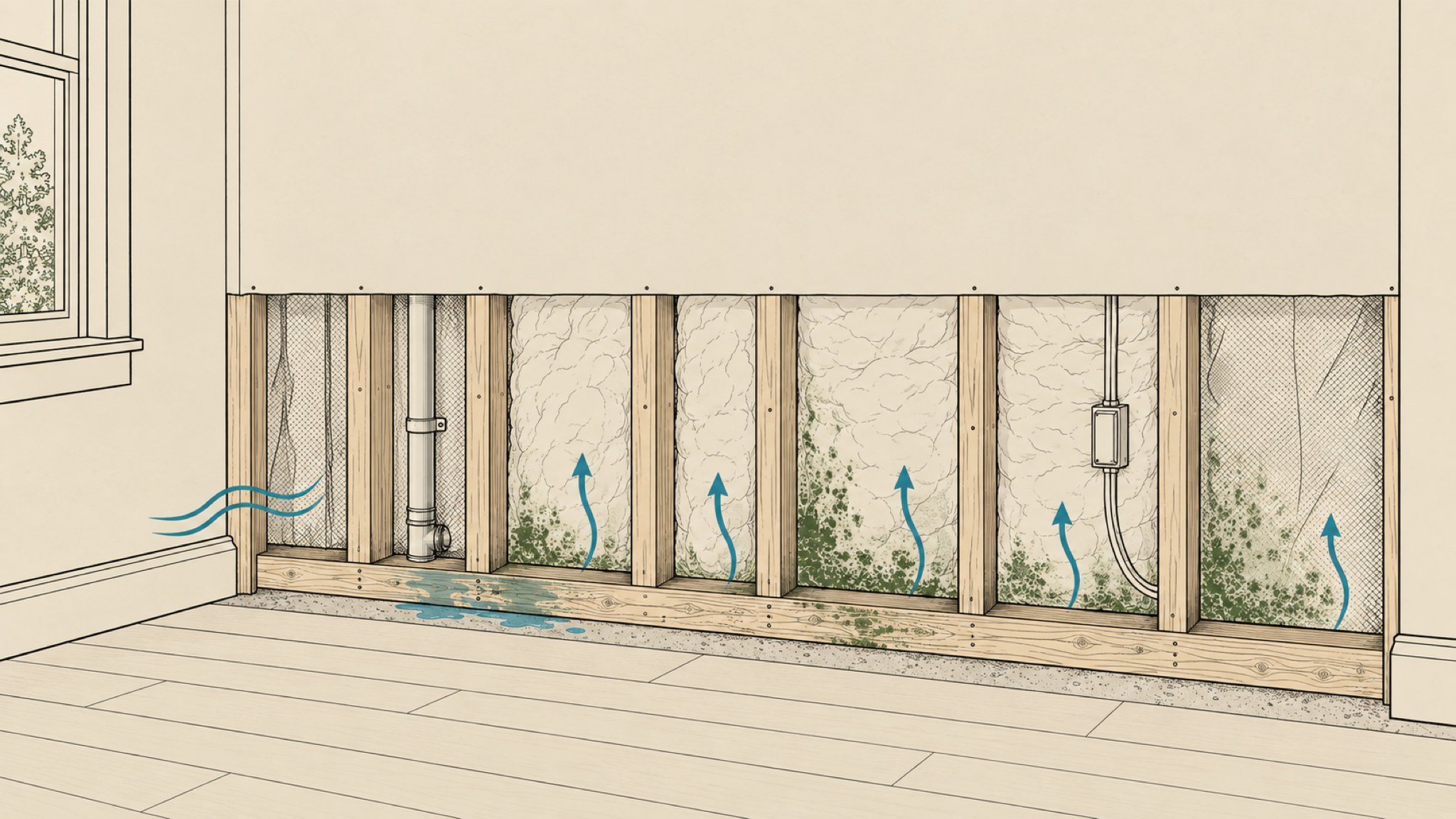
05
Inside the wall
In the cavity, insulation soaks up water, quits insulating, and holds the moisture against the framing. A closed wall cavity has no airflow, so it does not dry on its own, it just stays wet. This is where mold gets its start, in the place nobody can see.
06
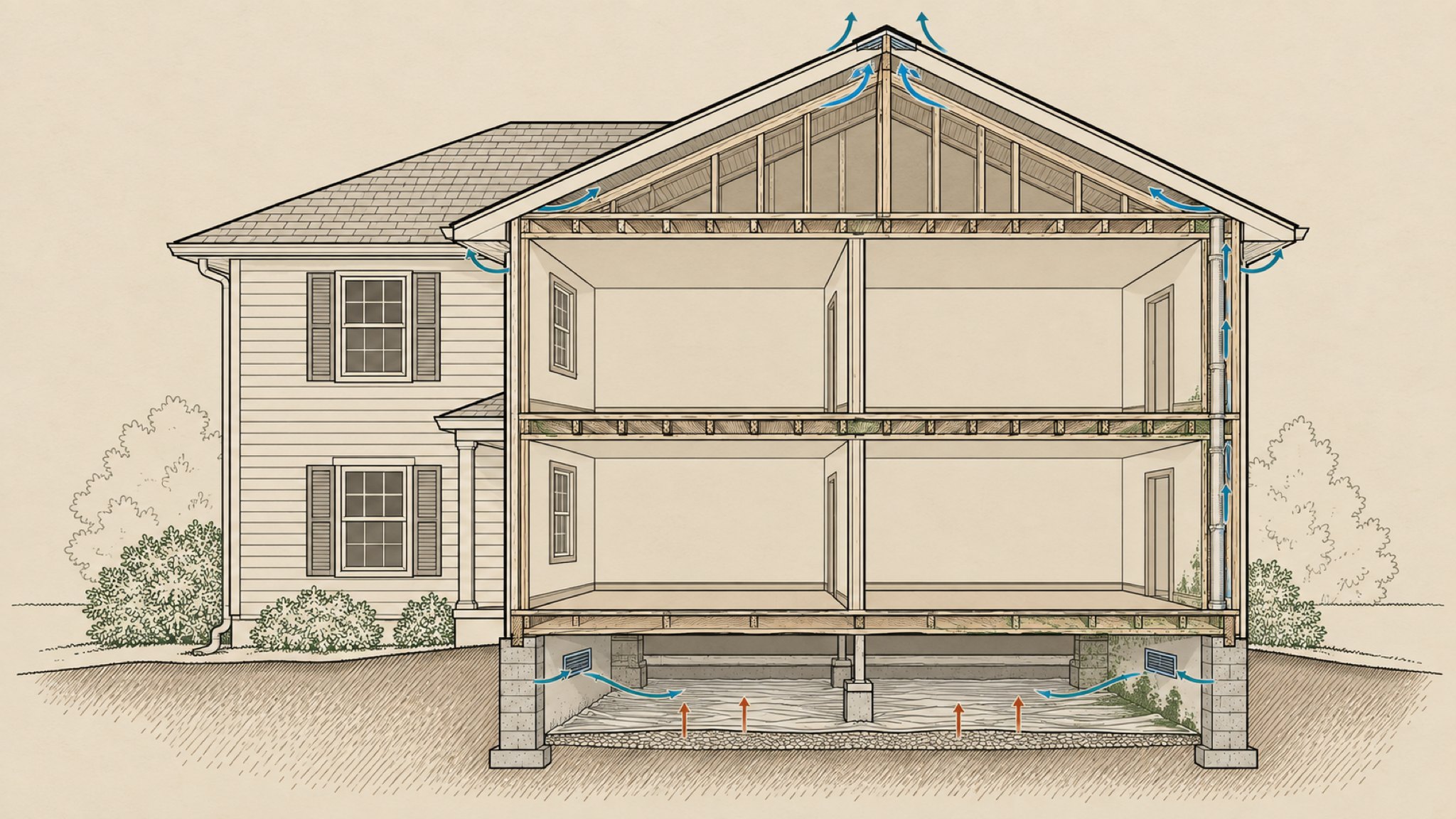
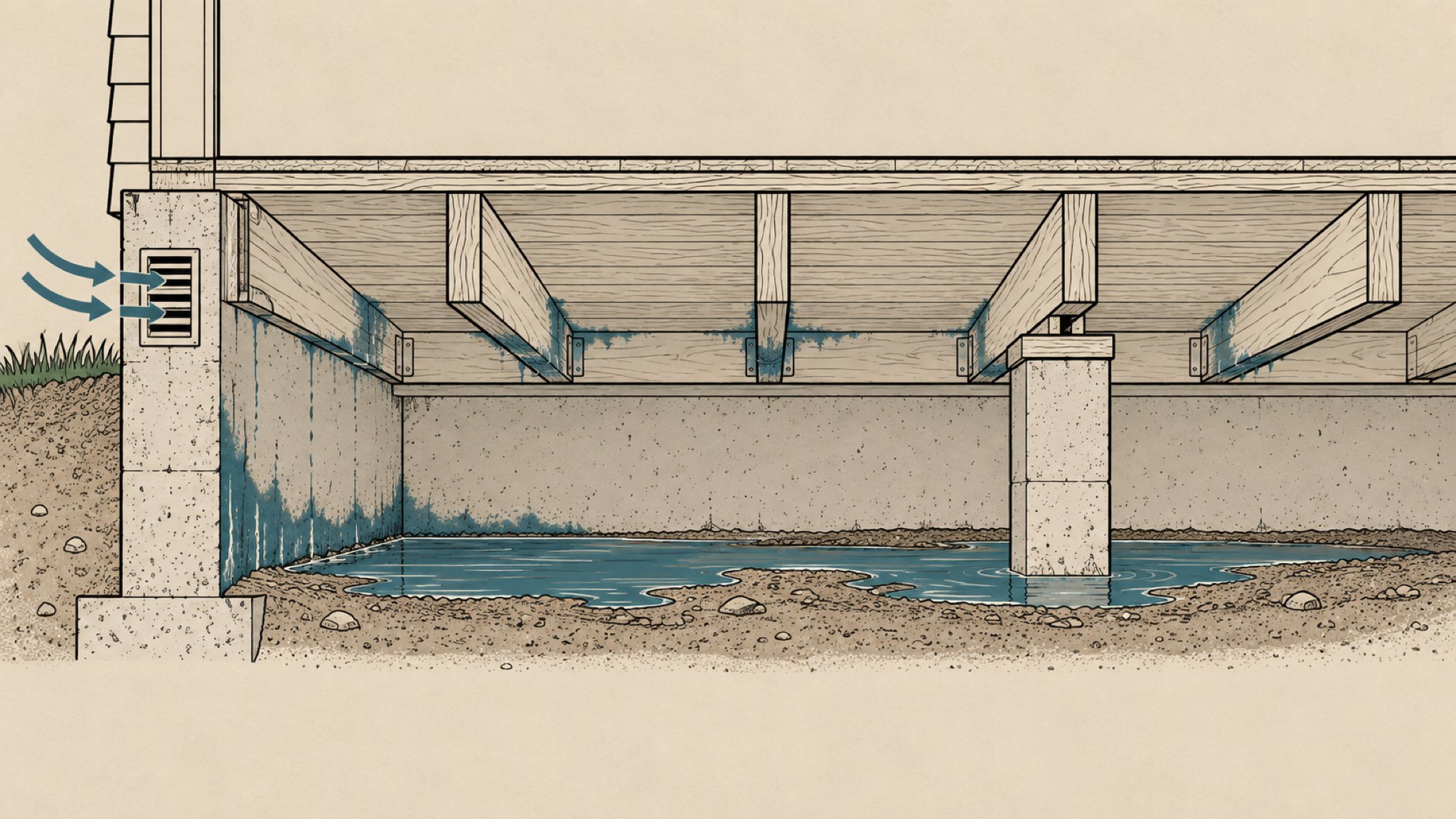
The lowest point in the house
Whatever the framing and insulation do not hold keeps moving down until it reaches the lowest point in the house: the crawlspace. From one failed line, water can be in an upstairs wall, the floor assembly, the first-floor walls, and the crawl at the same time.
07
What surface cleanup misses
Pull back to the whole house. Surface cleanup reaches exactly one thing in this drawing: the water you can see. The wall cavity, the joist bay, the wicked drywall, the insulation, and the crawl all stay wet, and moving air without dehumidification pushes moisture deeper and feeds mold in places you can't reach.
08
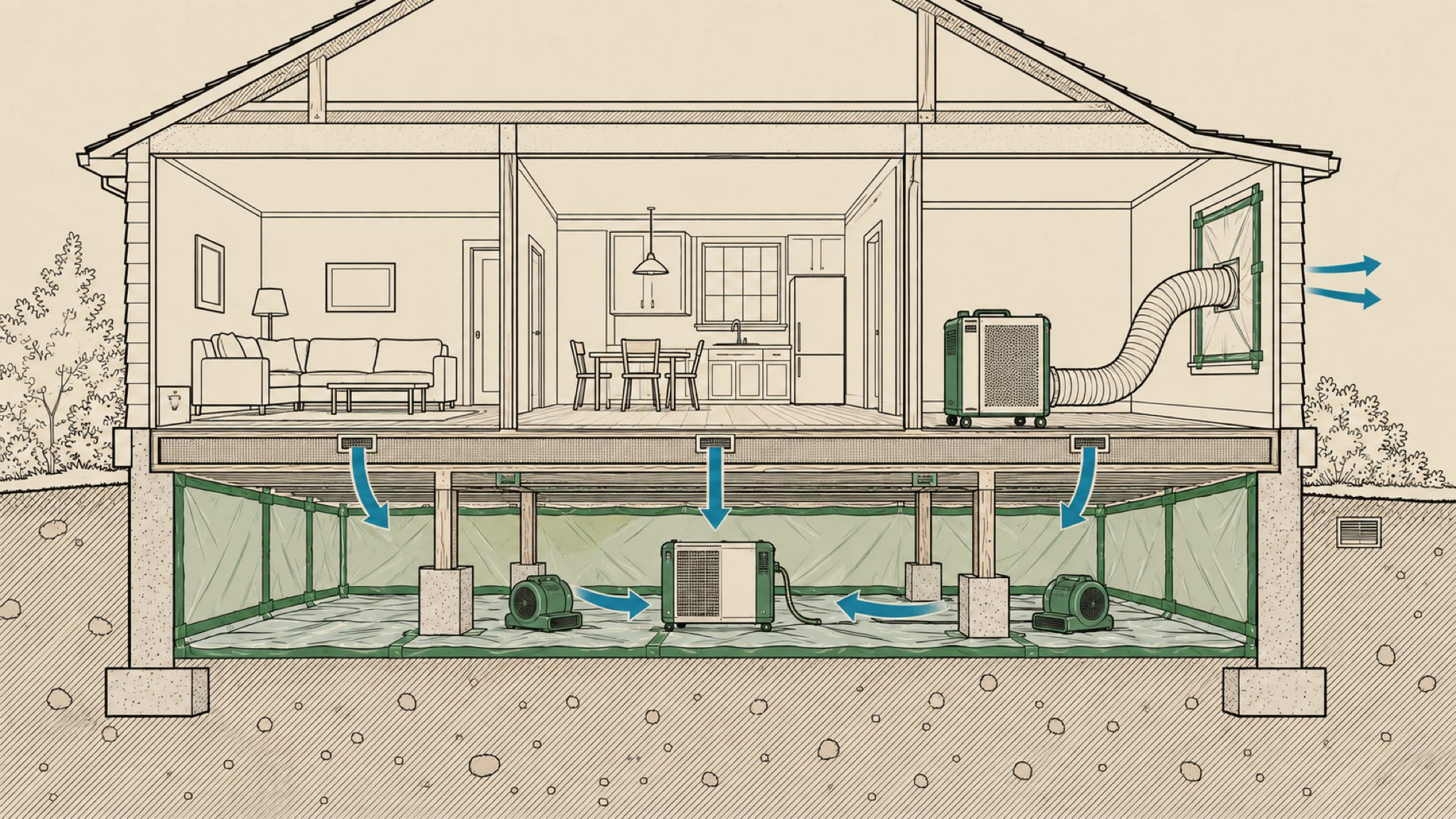
What proper drying looks like
Structural drying opens what the meter says to open, flood cuts above the wick line, baseboard off, then puts air movers on every wet surface, an LGR dehumidifier pulling the load, and an Injectidry manifold pushing air through the closed cavity. Readings every day until every material hits its documented dry standard. That is the difference between dried and covered up.


Clean, gray, or black water
What has to come out, what can be dried in place, and how careful everyone needs to be all follow from where the water came from. Pick what happened. The source of the water sets the scope.
Category 1, Clean water
The water started sanitary, a supply line, a water heater tank, a fridge line. The problem is wetting, not contamination, which means the clock matters more than the source. Everything it touched is wet; almost nothing it touched is ruined yet.
What typically must be removed
- Usually very little.
- Baseboard sometimes comes off, to dry the wall behind it, not because it is lost.
- Materials that were already failing before the water found them.
What can usually be dried and saved
- Carpet and pad can often be dried in place.
- Drywall, framing, and subfloor dry to a documented standard with the right equipment.
- Hardwood is frequently saveable when drying starts fast.
The water is not the hazard here, electricity is. Cut power to the wet area at the breaker before you touch anything, and stay off wet floors near outlets.
Category 1 does not stay Category 1. Time, warmth, and contact with soiled materials degrade it toward Category 2 and 3, and the removal list grows with it. This is the loss where speed saves the most material.
Categories per IICRC S500, the industry standard for professional water damage restoration. The category describes the water at the source, what it becomes depends on time, temperature, and what it travels through. What must be removed on a specific job is decided by inspection and moisture readings, not by a chart.
Your job page
Every job gets a private page you can open from your phone. What we found, what’s running, and what happens next, updated as we work rather than when you call to ask. Documented while it happens, not after.
1,300+ moisture readings documented this year, across 38,000+ square feet of structural drying.
- Job page
- Your private link: status in plain language, photos, documents, and the next step on the schedule.
- Readings
- Wood, drywall and subfloor metered at the same marked points every day, with temperature, relative humidity and grains per pound logged beside each one. Day one to demobilization, on a sheet you can read.
- Photos
- Numbered and dated, tied to the job record, the same set your adjuster gets.
- Paper trail
- A written scope and estimate in the format adjusters and property managers expect, handed over with the complete file.
When to call us
If one of these is your situation, the clock matters more than the diagnosis. Call first; we’ll sort out the rest on the phone.
- A supply line, water heater, or washing machine hose let go and water reached carpet, drywall, or subfloor.
- There is standing water in the crawlspace, or a wet ring on the ceiling under an upstairs bathroom.
- A dishwasher or refrigerator line has been leaking behind the cabinet and you do not know for how long.
- A pipe froze and broke while the house was empty and you are walking into it now.
- Someone already pulled the water and set fans, but the baseboard is still swelling and the floor still feels cool.
Not sure which one you have? Call and describe it.
What we see in Nampa
Field notes on Nampa: the housing stock, where the water comes from, and what that means for this work.
Old Nampa, the historic district around downtown, is craftsman bungalow and kit-catalog stock built roughly 1900 to 1940. Original crawlspaces, no vapor barrier, and where there's a partial basement there's usually no perimeter drain either.
Canyon County runs on gravity irrigation. When the canals and laterals charge in April the shallow water table comes up with them, and crawlspaces that were dry all winter take standing water in May with no plumbing failure anywhere in the house.
The Lake Lowell side of town sits over naturally shallow groundwater. We get called for a musty smell, open the crawl hatch, and find saturated soil, rusted duct boots, and growth on the underside of the subfloor.
The newer subdivisions off Middleton Road, Greenhurst and Southside Boulevard fail differently: PEX fittings, builder-grade water heaters and refrigerator ice-maker lines instead of aging galvanized.
Nampa has a large rental and manufactured-home segment, and those losses get reported late because a tenant calls a landlord first. By the time we're dispatched the water has been down a day or more, so the conversation is already about microbial growth, not just drying.
Working across:Downtown Nampa, Lakeview, Karcher, Midway, Sunny Ridge
Questions we get
Straight answers, including the ones that occasionally talk someone out of hiring us.
Does the flooring have to come out?
Not always. Hardwood, tile over concrete, and many hard surfaces dry in place with mat systems and directed airflow. Carpet pad, wet fibrous insulation, and laminate almost never do. Laminate swells and does not come back. The water category and how long the material has been wet decide it, and we tell you which it is before anything gets cut.
How long does drying take?
Most residential water losses dry in three to five days. That number comes from daily moisture readings, not from a schedule. Dense assemblies like hardwood over a wet subfloor take longer, and a Category 3 loss adds removal time before drying can even start.
What is the difference between clean, gray, and black water?
Category 1 is clean water from a supply line or water heater. Category 2 is gray: dishwasher and washing machine discharge, toilet overflow with urine only. Category 3 is black: sewage, ground surface water, or any water that has sat long enough to grow bacteria. Category 3 requires containment, PPE, and removal of the porous materials it touched.
Will my insurance cover this?
Sudden and accidental water damage is covered under most homeowner policies. Long-term seepage and maintenance failures usually are not, and your carrier decides which one yours is. We document the loss with photos, moisture readings, and a line-item estimate in the format your adjuster reads, and if the adjuster has a question about our scope or our readings, we answer it. The claim stays in your name and you see the same file the adjuster gets.
Can I just run my own fans and a rental dehumidifier?
For a small spill on a hard surface, yes. For anything that reached drywall, insulation, or subfloor, box fans move air without removing moisture. You push humid air into wall cavities and grow mold in a place you cannot see. LGR dehumidifiers pull water out of the air at rates rental units do not reach.
Do you have to come every day?
Yes, while equipment is running. Daily readings are how we know the drying is working, and they are what makes the file hold up when your carrier reads it. Visits are short. Between visits you can watch progress, readings, and photos on your own job page.